Armistice Agreement - Panmunjom


(Click the picture for a larger view)

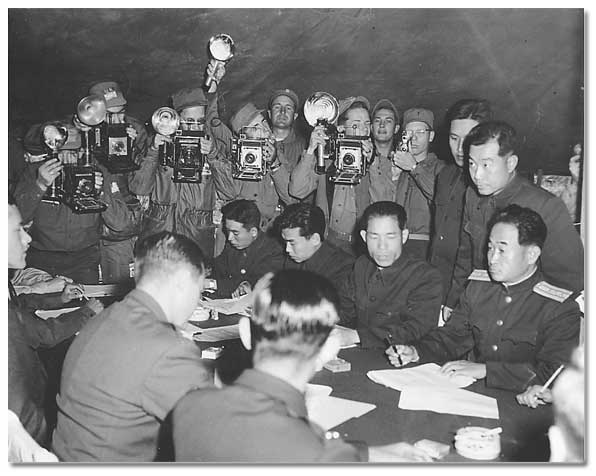
This official U.S. Navy photo is dated 23 October 1951. Many long months would pass before the Armistice Agreement, whose text appears on this page of The Korean War Educator, would also be signed. Photo courtesy of Bob Busch, St. Louis, MO.

Left to right (backs to camera) UNC Liaison Officer Col. James C. Murray, USMC; Senior UNC Liaison Officer Col. Andrew J. Kinney, USAF; Lt. Col. Lee Soo Young, ROKA, UNC Liaison Officer, (with shoulder boards across the table) Senior Communist Liaison Officer Col. Chang Chun San.

Although the American public doesn't hear much about it, the stalemate which began in Korea in July of 1951, continued in 1952 and carried over into 1953. While peace talks lumbered on, the fighting continued, and thousands of young American men died a needless death. From a very mobile war, the Korean War had by that time transformed into a "static" war. Men died to hold ground that had already been gained, and to gain back ground that had been lost to the enemy. Government leaders back in Washington, D.C. were reluctant to widen the war. Their fellow countrymen were sick and tired of war, and moms and dads wanted their boys to come home. Through negotiations, the major sticking point that was causing the stalemate in the peace talks--the prisoner of war issue--was resolved. A cease fire would go into effect on July 27, 1953, and voluntary repatriation of prisoners of war would begin under the watchful eye of the United Nations Command.

The full text of the Armistice Agreement can be read by clicking on the link below. In addition, the photo link below will take our viewers to a number of Panmunjom-related photographs. The official US Navy photographs shown on this page are from the private collection of retired St. Louis (Missouri) police lieutenant Robert J. Busch. Bob served in the US Navy from 1944 until December of 1952, when he was discharged as a Chief Boatswain Mate.

The Armistice Agreement

Armistice Agreement (PDF File)

Note: Due to the overwhelming size of this document and the formatting needed to make it legible, it is available in PDF format rather than as a web page. This will facilitate uniform printing as well.

News Release - Dallas Morning News

[Copyrighted by the Dallas Morning News (Dallas, Texas).  This article appeared on the front page of the Dallas Morning News dated July 27, 1953.]

Armistice Signed by U.N., Reds;
Shooting Stops at 7 A.M. Today
Early Return of POWs Set

Panmunjom (Monday) (AP).—The United Nations and the Communists finally signed the hard-bargained Korean armistice Monday, ending thirty-seven months of war, but both top commands quickly warned their troops that a truce did not necessarily mean a peace.  The Chinese Communists in Peiping immediately broadcast a claim that the Red forces had won “a glorious victory.”  By terms of the armistice signed at 10:01 a.m. Monday (7:01 p.m. Sunday, Dallas time) the guns were to cease firing not later than 10 p.m. Monday (7 a.m. Monday, Dallas time).

The main ceremony was a cold, 10-minute formality in Panmunjom by Lt. Gen. William K. Harrison, American representing the U.N. command, and Gen. Nam Il of North Korea, representing the Chinese and Korean Reds. Shortly afterward, Gen. Mark W. Clark, United Nations supreme commander, countersigned the eighteen documents—nine copies for each side—and issued a warning statement to his forces. Clark said the armistice does “not mean an immediate or even early withdrawal” from Korea.  “It does mean that our duties and responsibilities during the critical period of the armistice are heightened and intensified rather than diminished,” he said.  “The conflict will not be over until the governments concerned have reached a firm political settlement.  “Meanwhile, we remain—in strength—a reminder to the enemy and his emissaries that our might and power stand behind the pledges of the United Nations to defend the Republic of Korea against any aggressor.”

Gen. Maxwell D. Taylor, Eighth Army commander, warned similarly that the armistice was “just a suspension of hostilities, which may or may not be preparatory to permanent peace.”  The Chinese and North Korean commanders, Gen. Peng Teh-huai and Marshal Kim Il Sung, were due to countersign the truce documents somewhere in North Korea. Meanwhile, the Peiping Red radio broadcast the Red commander’s order of the day to cease firing at 10 p.m.  The order said the Reds had won “a glorious victory” but warned them to “guard against aggressive and disruptive actions from the other side.”

Ignoring the North Korean invasion of the South on June 25, 1950, and the Chinese intervention Oct. 25, 1950, the Communist order of the day said the Red troops had fought heroically “for three years against aggression and in defense of peace.”  The formal signing ceremony by Harrison and Nam Il was a cold and silent one in this hamlet near the thirty-eighth parallel, where the war began and near which the stalemated armies have been locked for two years past.

They met in a jerry-built but ornate structure with an Oriental pagoda roof in this war-ruined wayside village of Panmunjom which the Koreans called, “The inn with the wooden door.”  They began at 10:01 a.m. (7:01 p.m. Dallas time, Sunday) and finished exactly ten minutes later. They separated in silence, but not before exchanging one long, searching look.  Three hours later, at 1:01 p.m. (10:01 p.m. Dallas time, Sunday), General Clark signed at the Allied advance headquarters in Munsan and sent the copies off to North Korea.

The Red chiefs, Chinese General Peng and North Korean Marshal Kim, were to send their signed copies down to Clark. These were anticlimactic signatures. Unable to agree on meeting at Panmunjom, the top commanders had agreed that Harrison and Nam Il would do the signing that set the armistice in motion.

The strokes of their pens on the eighteen copies of the armistice document touched off reactions around the world, from the hilly battlefields of Korea where troops have fought in mud and dust and snow, to the world capitals where diplomats have pondered the Korean crisis and what to do about it.  President Eisenhower in a radio-television address to the American people from Washington hailed the armistice with thanksgiving. He declared the United Nations had met the challenge of aggression with “deeds of decision” and warned that the United States and its allies must remain vigilant.  Marshal Kim in a broadcast to his troops ordered the firing to cease at 10 p.m.

In New York, Lester B. Pearson of Canada, president of the U.N. General Assembly, said the Assembly would meet Aug. 17 to consider plans for a Korean political conference.  Before that conference is convened to work on the tremendous problems wrapped up in the future of a Korea divided and fought over by the Communist and free worlds, other events decreed by the armistice must come to pass.

The fighting men of Communist China and Korea on one side and South Korea, the United States and fifteen other allied nations on the other must pull back from the cease-fire line, leaving a demilitarized buffer zone 2½ miles wide across the Korean peninsula.  Along their new line they must dig in and wait while others decide whether the armistice will resolve into permanent peace.

The prisoners of war—all who want to go home—must be exchanged at this historic little mud-hut village where the armistice was signed. These include about 3,500 Americans, 8,000 South Koreans and about 1,000 from other allied nations. The exchange should start within the week. Prisoners who refuse repatriation—there are about 14,500 Chinese and 8,000 North Koreans—will be given explanations by countrymen designed to allay their fears. Then if they still resist after 90 days the political conference will be handed the problem.  That’s one more tough nut for the conference, and if it can not crack it in thirty days, the prisoners will be released to civilian status in South Korea, with the right to go to neutral countries of their choice.

Representatives of four neutral nations—Sweden, Switzerland, Poland and Czechoslovakia—are charged with observing the armistice. A fifth, India, will join these four in supervising prisoners who resist repatriation, and India will supply guards. President Syngman Rhee of South Korea declared after the signing that the Republic of Korea would not disturb the truce for “a limited time” while a political conference attempts to liberate and unify Korea. Rhee wants a unified Korea, and may decide to fight for it if the conference can not realize his ambition.

These are the vistas opened and the burdens summoned by the armistice which was signed Monday. Newsreel and television cameras hummed steadily and still cameras clicked at intervals throughout the ceremony. Combined radio networks broadcast a description of the momentous ceremony. A Communist newsman asked Harrison outside the signing hall, “Any comment?” “You know I don’t do that,” Harrison replied.

Thus drew to a close the stalemated conflict which the United States and the United Nations entered as a “police action” against Communist aggression. Within three days to a week prisoners will begin to flow homeward. The momentous announcement that the United Nations command and the Communists had agreed to a cease-fire after two years, seventeen days of negotiations was made in Tokyo Sunday night by General Clark.

An official allied spokesman said the record of the months of secret negotiations would not be made public until after the armistice is signed. No representative of South Korean President Syngman Rhee was expected to witness the signing of a truce which leaves Korea divided.

Pyun Yung-Tai, Rhee’s fiery Republic of Korea foreign minister, promised in a statement that neither the ROK people nor the army will revolt against an armistice “at this time.” But Pyun reiterated to newsmen the conditional ROK stand that it had promised the United States not to oppose a truce only until the post-armistice political conference has had ninety days to unify Korea. The United States has assured the Reds it is imposing no such time limit.

Clark indicated the ordeal of 12,000 Red-held war prisoners—2,938 Americans, 8,000 Koreans and about 1,000 from other allied nations—will end in a few days. He told a reporter if the Reds cooperate prisoner exchange may begin within a week or sooner and the first freed Americans will be home in from two to three weeks.

Even after the announcement that agreement had been reached on a cease fire, small Communist units attacked Allied outposts on the western front, but were repulsed, the United States Eighth Army reported. The Red attacks came after the Communists momentarily stepped up artillery and mortar shelling. Allied warplanes bombed as usual, while the battleship New Jersey bombarded Wonsan, the east coast Red port battered by two and one-half years of shelling. Allied air and ground commanders were given orders empowering them to do whatever necessary to minimize casualties in the final, delicate hours of the war.  United States Eighth Army division commands had permission to use their own judgment on offensive action, with the general intent of not forcing action on the Reds unless they asked for it. Secret orders, presumably along the same lines, were issued to the United States Fifth Air Force. Other sealed orders, presumably for after the cease fire, were given Allied troop commanders.

As of last Wednesday, 24,965 Americans had died in the three-year war. Another 13,285 were missing and 103,760, including 2,392 who later died, were wounded. For the Allies the human cost was 72,000 killed in combat, 270,000 wounded, 84,000 captured or missing. Red losses were estimated at 1,400,000. “I hope the end of hostilities will foreshadow the beginning of a peace for the world as well as for ravished Korea,” Clark said, in announcing the agreement. He warned that “a long and difficult road still lies ahead, and there are no shortcuts.” The U.N. commander issued his statement en route to Korea from Tokyo.

News Release - New York Times

[Copyright by the New York Times, July 27, 1953]

Truce Is Signed, Ending The Fighting In Korea;
P.O.W. Exchange Near; Rhee Gets U.S. Pledge;
Eisenhower Bids Free World Stay Vigilant
Ceremony Is Brief
Halt in 3-Year Conflict for a Political Parley Due at 9 A.M. Today

By Lindesay Parrott
Special to The New York Times

RELATED HEADLINES
President Is Happy: But Warns in Broadcast That Global Peace Is Yet to Be Achieved
Talk Condition Set: U.S. to Boycott Political Parleys After 90 Days if It Finds Foe Stalls
Defense Chiefs See Billion Cut In Arms: Wilson Tells Quantico Parley Our Gain in Might Makes Any Attack on Us 'Foolhardy'
Marines Stop Reds In Last-Hour Fight: Chinese Foe's Dawn Attacks Hit U.S. Units on West and South Koreans in Center
Clark Ready to Start Release Of Red Captives in Few Days: But Allied Commander Says It May Be Two or Three Weeks Before Americans Freed by the Communists Arrive in U.S.
U.N. Assembly Meets Aug. 17 To Plan Post-Truce Parley
Skeptical G.I.'s Finally Convinced; Most Take News With Little Elation

Tokyo, Monday, July 27--Communist and United Nations delegates in Panmunjom signed an armistice at 10:01 A.M. today [9:01 P.M., Sunday, Eastern daylight time]. Under the truce terms, hostilities in the three-year-old Korean war are to cease at 10 o'clock tonight [9 A.M., Monday, Eastern daylight time].

[President Syngman Rhee of South Korea promised in a statement at Seoul Monday to observe the armistice "for a limited time" while a political conference tried to unify Korea by peaceful means, The United Press said.]

The historic document was signed in a roadside hall the Communists built specially for the occasion. The ceremony, attended by representatives of sixteen members of the United Nations, took precisely eleven minutes. Then the respective delegations walked from the meeting place without a word or handshake between them.

The matter-of-fact procedure underlined what spokesmen of both sides emphasized: That though the shooting would cease within twelve hours after the signing, only an uneasy armed truce and political difficulties, perhaps even greater than those of the armistice negotiations, were ahead.

Signers Are Expressionless

The representatives of the two sides were expressionless as they put their names to a pile of documents, providing for an exchange of prisoners, establishment of a neutral zone for the cease-fire and a later political conference that would attempt to settle the tragic Korean questions, unsolved by three years of fighting that caused hundreds of thousands of casualties.

According to the latest figures, revealed July 21 by the Department of Defense, the United States has suffered a total of 139,272 casualties. This included 24,965 dead, 101,368 wounded, 2,938 captured, 8,476 missing and 1,525 previously reported captured or missing, but since returned to military control.

Early this afternoon the Allied part in conclusion of the armistice agreement was completed at advance headquarters near Munsan, where Gen. Mark W. Clark, United Nations commander, put his name to the documents previously signed at Panmunjom. General Clark signed in the presence of some of his high-ranking officers, Vice Admiral Robert P. Briscoe, commander of the naval forces in the Far East; Gen. Otto P. Weyland, head of the Far East Air Forces; Gen. Maxwell D. Taylor, Eighth Army commander; Lieut. Gen. Samuel Anderson of the Fifth Air Force, and Vice Admiral J. J. Clark, heading the Seventh Fleet.

Also present at Munsan was Maj. Gen. Choi Duk Shin, former South Korean representative on the United Nations armistice team. General Choi, who walked out of the meetings at Panmunjom last May, also had boycotted the ceremony there this morning. As a result, no South Korean representative signed the truce, which South Korea will observe, at least temporarily, but did not approve.

Almost simultaneously, General Clark's headquarters in Tokyo released a message the general had written in advance of the armistice--a grim warning that the mere military armistice would not permit the United Nations to relax its vigilance against communism.  "I must tell you as emphatically as I can," said the statement, addressed to all members of the United Nations Command, "that this does not mean immediate or even early withdrawal from Korea. The conflict will not be over until the Governments concerned have reached a firm political settlement." General Taylor, at Eighth Army headquarters in Korea, echoed General Clark's views and warning. "There is no strong feeling that our problems here are over, nor that the armistice is an occasion for unrestrained rejoicing," he said.

For the United Nations, the documents were signed at Panmunjom by Lieut. Gen. William K. Harrison Jr. For the Communists, the signer was Lieut. Gen. Nam Il of North Korea, a Russian-trained school teacher who donned a military uniform after the outbreak of the Korean war.

Each Signs Nine Times

Seated at separate tables, each put his name nine times to nine copies of the armistice agreement in English, Korean and Chinese. On General Harrison's table stood a miniature flag of the United Nations. The North Korean flag decorated the Communists' place in the meeting house. On a central table lay piled copies of the agreement, bound in stiff blue cardboard covers. Aides passed them in turn to the two signers. Pooled dispatches over Army communications from Panmunjom said General Harrison signed the first copy of the agreement at 10:01 A.M. General Nam put his signature to the final copy at 10:11 o'clock, ending the brief ceremony.

Because of what General Clark called unreasonable restrictions demanded by the Communists, the top military leaders of the opposing armies did not appear at the session. The enemy, it was revealed, had demanded that if Marshal Kim Il Sung, North Korean Premier and Commander in Chief, and Gen. Peng Teh-huai, commander of the Chinese Communist troops in Korea, came to Panmunjom, all correspondents and all representatives of South Korea would be barred from the neutral zone. General Clark refused.

Following signing of the truce documents by General Clark, the agreement was scheduled to be sent to Marshal Kim and General Peng. Their names probably will be affixed in their secret headquarters near the bombed out North Korean capital of Pyongyang. The United Nations delegation appeared on the scene at 9:30 o'clock this morning, alighting from helicopters that had brought them from Munsan, and filing past a guard of honor representing all units and services fighting on the peninsula.

Allied Observers Present

General Harrison was accompanied by his fellow American delegates, Rear Admiral John C. Daniel, Brig. Gen. R. N. Osborne and aides. The observers from the United Nations members lined the Allied section of the hall. There were representatives of Turkey, Thailand, the Netherlands, France, the United Kingdom and the Commonwealth countries, Colombia, Belgium, Denmark, Luxembourg, Ethiopia, Philippines and Norway.

The Communists came to Panmunjom in a fleet of jeeps, thirty-five correspondents of Iron Curtain countries accompanying them. Altogether, it was calculated that there were 130 press and radio correspondents and photographers of many nations in the hall.

Outside the thin wooden walls there was the mutter of artillery fire--a grim reminder that even as the truce was being signed men were still dying on near-by hills and the fight would continue for twelve more hours.

As the delegates settled in seats, aides took the bound copies of the armistice agreement from the central table and passed them to their chiefs. Marine Col. James C. Murray, one of the few Americans present today who saw the start of the truce negotiations two years ago, handed the documents to General Harrison and pointed out to him the place where he should sign. Both General Harrison and General Nam used a single fountain pen. Lieut. Col. H. M. Orden of the liaison officers group blotted General Harrison's signatures and returned the documents, one by one, to the central table, from where they were passed to General Nam by a North Korean colonel, You Ju.

At no point in the armistice negotiations have the delegates given each other greetings beyond a possible silent nod. The procedure was the same today. At one point General Harrison whispered briefly to Colonel Orden and an interpreter, Lieut. Kenneth Wu. There was a click of cameras and the grinding of newsreels. Otherwise, only the distant artillery broker the silence. At 10:10 A.M. General Harrison finished, and General Nam one minute later. The North Korean general glanced at his watch, rose and strode quickly from the hall, without a glance at the United Nations table.

General Harrison strolled out in more leisurely fashion. To correspondents who asked him for comment, he replied: "You know I don't do that." But he smiled and posed for pictures, saluted the honor guard and greeted some United Nations representatives before he climbed into a helicopter to fly back to Munsan at 10:27 A.M. Inside the hall, the signed documents remained on the central table, watched by security guards and liaison officers, who remained for a brief meeting with interpreters. Presumably they were arranging the later signing of the armistice by the high commanders.

Seventy-two hours after the signature of the armistice, the troops will withdraw one and a quarter miles from the fighting line, and a neutral zone will be established between the armies. Within a few days the first of returning United Nations war prisoners might be expected to trickle in. They are expected to reach their homes probably next month.

General Clark flew to Korea late yesterday afternoon to play his part in the revamped signing ceremonies. The armistice negotiations were closing on the same note of scarcely veiled hostility and accusations of bad faith with which they began more than two years ago. General Clark, landing in Korea, made it clear he also had scant hope the truce would go far to solve the tangled problems of a divided Korea. "A long and difficult road still lies ahead," he warned. "There are no short cuts. If we are to honor the great sacrifices which have been made in the name of freedom, if we are to achieve peace, if we are to uphold the principles of freedom justice and human dignity we must continue our efforts toward peace and we must be ready to defend these principles whenever and wherever they are challenged."

Persons close to Dr. Rhee said his major interest today centered on a political conference that is to follow the truce, with the armistice for the time being regarded as an accomplished fact despite his former stubborn opposition to the cease-fire.

Thus far, there was little knowledge here just what the conference will do, and even how it will be constituted. The armistice agreement itself states only that the commanders in the field "recommend to the Governments concerned" that the meeting be held to negotiate a withdrawal of foreign troops from Korea, a peaceful settlement of the Korean question, "etcetera." No mention was made of what Governments would be included or of the question of unification of Korea, which Dr. Rhee demands. Neither is the word "etcetera," on which the Communists insisted during the truce negotiations, further defined.

The Communists, it has been suggested, meant to bring in under that word such questions as Chinese Communist admission to the United Nations and the status of the Chinese Nationalist regime on Formosa. Dr. Rhee, on the other hand, has stated that unification of Korea will be the conference's immediate task, and he is understood to have been disappointed over the supposed failure of the United States to clarify further conversations to that effect he held with Walter S. Robertson, Assistant Secretary of State for Far Eastern Affairs.


View and/or Sign Our Guestbook
Note, Guestbook entries prior to August, 2008
have been archived to PDF, and can be viewed here:
6/21/2001-7/6/2005
7/6/2005-9/18/2006
9/28/2006-8/13/2008


Your donation helps to
keep this web site FREE.


| Contact | What's New | About Us | Korean War Topics | Support | Links | Memoirs | Buddy Search |

© 2002-2011 Korean War Educator. All rights reserved. Unauthorized use of material is prohibited.

- Contact Webmaster with questions or comments related to web site layout.
- Contact Lynnita for Korean War questions or similar informational issues.
- Website address: www.koreanwar-educator.org 
Problems with or Questions about PDF Files - Click HERE for more PDF information.
 

Hit Counter
 
.