Introduction
It takes much more than infantry troops to fight and win a war. As Sal Gionfrida of Hampton, Virginia
explains, "Without supporting units, war would be a disaster for the guys squeezing the trigger." The men on
the front line in Korea had it bad, there is no question of that. However, they were not the only ones to
suffer the terror, the cold, Bedcheck Charlie, and the stench of human feces and death in the Korean War.
This page of The Korean War Educator is devoted to those Americans who served behind the lines (and on
the line and in front of the line) in a wide variety of capacities, including military police, medical
personnel, engineering battalions, graves registration, and much more. Please realize that many of these
"behind the lines" support troops were often within yards of the front line, and they faced death many times
during their stint in Korea.
Korean War veterans are invited to help expand this page of the Korean War Educator by supplying
photographs, information, and memoirs which will educate the public about their company's role in the Korean
War. Send materials to: Lynnita Brown, 111 E. Houghton Street, Tuscola, IL 61953 or e-mail
lynnita@koreanwar-educator.org. Materials will be
returned upon request.
Page Contents:
Back to Page Contents
Chaplains
(Coming soon)
Back to Page Contents Engineers - 24th Engineer Construction Group
(Information copied verbatim from an engineer construction group history)
This is the story of the first two years of Korean duty of the 24th Engineer Construction Group, from the
time of its landing at Pusan on 7 December 1950 to the present. Commanded by Colonel Emil F. Klinke, the
24th arrived from Ft. Belvoir with but one attached unit—the 402nd Engineer Panel Bridge Company. In the two
succeeding years, however, many units have served with the 24th, from Madong to Seoul.
The 24th officially began its tour with the Eighth United States Army in Korea on 10 January 1941, being
then placed in support of X Corps. With Group, as they began two years of rebuilding in Korea, were the 79th
Engineer Construction Battalion, the 74th Engineer Heavy Equipment Company, the 538th Engineer Field
Maintenance Company, and the 1201st Engineer Construction Group (ROKA). They were joined shortly thereafter
by the 44th Engineer Construction Battalion, the 86th Engineer Searchlight Company, and the 573rd Engineer
Ponton Bridge Company.
Early in February, Group moved 120 miles north to Sangju, where four units were attached pending arrival
of the 32nd Group. These were relieved on 22 February 1951. During that month, the 86th Searchlight Company
and the 1201st Group (ROKA) left, and the 313th Engineer Utilities Detachment joined. The following month,
Group moved to Changhowon-ni, where the 453rd Engineer Construction Battalion joined our family.
During this period, Group was concerned primarily in improving the MSR from Ulsan to Andong. In less than
two months this road was converted to a two way military supply route; thirty (30) bridges were strengthened
for class 50 ton traffic; mountain passes were widened, and improved road drainage instigated. Native Korean
labor played an important part in this major undertaking.
In the latter part of February, Group entered a new phase of operations. Switching to IX corps, we began
the Herculean task of completely rebuilding fifteen (15) bridges previously destroyed by enemy action. That
this task was carried out in a minimum of time, despite serious shortages of supplies, speaks well for the
capabilities of the officers and men of units of the 24th Group.
Another job worthy of notice was the construction, by the 74th Engineer Heavy Equipment Company, of the
4,500-foot airstrip at Hoengsong in only five (5) days! Another eighteen days saw the completion of parking
aprons, overrun, drainage and road relocation.
During this period, also, our family moved its headquarters to its present location in the National
University of Seoul area, about 7 miles northeast of Seoul; the 2998th Engineer Treadway Bridge Company
joined; the 453rd left us to be replaced by the 62nd Engineer Construction Battalion; and we were forced to
evacuate our pleasant headquarters area at the university for a temporary location at Inchon.
Back at the Seoul location in early June, Group started to rebuild again. Task after task was assigned to
our units. Many of them large bridge building jobs such as Forney, Binyon, Han Hi-Level bridges at Seoul and
Chungju, Hwachon, etc. There was also the Seoul-Chunchon railroad to rebuild, in spite of interruption by
enemy action. Two large hospitals, a couple of schools, and some POW camps were included in the growing list
of jobs tackled and successfully completed by units of the Group.
Early in 1952 the 2998th Engineer Treadway Bridge Company was relieved of assignment. In May of 1952 the
573rd Engineer Ponton Bridge Company was attached to the 62nd Engineer Construction Battalion for operation
and administration. In November 1952, the 402nd Engineer Panel Bridge Company was relieved from assignment
to Group, and in December the 528th Engineer Field Maintenance Company was also relieved of assignment. At
present, the Group units are: 62nd Engineer Construction Battalion, 79th Engineer Construction Battalion,
74th Engineer Heavy Equipment Company, 573rd Engineer Ponton Bridge Company, and 313th Engineer Utilities
Detachment.
We speak of the units in the Group, but these are made up of people—men who, in spite of many personal
discomforts and often in complete disregard of personal safety, continued to do their job. Whether it is
weather so hot and dry that ones lungs ache with every breath, or so wet and cold that it seems that one
will never again know what comfort means, the men of 24th Group have continued to build the bridges and
roads and airstrips that are so vital in today’s modern warfare, and so especially difficult in the Korean
terrain: Men like Colonel Klinke, who provided the inspiration and technical ability to enable the Group to
build 182 bridges in two years; Major Frank Parker, who performed brilliantly as Group Operations Officer
until he was killed in an air crash in June of 1952; Captain John T. Cicur Jr., the pilot on that ill-fated
day, who flew innumerable hours in the furtherance of our mission; 1st Lt. Charles R. Smith, who came to
Korea with the 44th Engineer Construction Battalion as a Sergeant, and who was the sparkplug in the
construction of Carney Bridge, and many, many more who have given unsparingly of themselves.
In two years we have had almost a complete turnover of officers and men, yet the new arrivals do not
hesitate to pick up the challenge left by those departing for more pleasant shores. We feel that the 24th
Group can uphold its part of the traditions of the Corps of Engineers.
Naturally, a great part of our work has been in the construction and rehabilitation of bridges, both
highway and railroad. These range in size from a 20-foot concrete bridge on the Group access road to the
Carney Bridge over the Han River. Both Contractor and Army personnel are employed in the construction of the
latter bridge, which is reputedly the second largest bridge in North and South Korea, and the largest
undertaken by the Engineers in Korea.
In July 1951 a contract was let for a survey to determine the condition of all piers and footings of the
Carney site, and to determine position of sunken superstructure, and the feasibility of salvaging a sunken
M-2 treadway bridge. Work also started on the construction of two spans at the North and South ends. These
two spans were completed in September 1951. Also in September, a contract was let for the clearing of steel
from the bottom of the river, and driving of timber piles. This contract was never completed as insufficient
penetration was received due to bed rock being located approximately 5 feet below river bottom. At this time
the use of pneumatic caissons and permanent concrete piers was decided upon. A contract was let for the
construction of the required 8 caissons and concrete piers. Progress was delayed during this period due to
heavy rains and a rise of 12 feet in the river, above normal water level. During this flood 2 of the
caissons were damaged and had to be reset and repaired. The month of August 1952 saw the completion of these
caissons, and preparations were made for the launching of 75" built-up steel girders. These 75" girders were
prefabricated by the contractor and hauled to the site. The first of these girders was launched in October
1952. Upon completion, this bridge will be 3,420’ long and 45’ above normal water level. Approximately
1,410’ of this bridge is being constructed and the remaining portion repaired and resurfaced. The original
bridge was a concrete "T" beam structure with steel through truss-supported spans over the wet section.
The Cho Hung Construction Company of Seoul did much of the work on the bridge under the supervision of
the 44th Engineer Construction Battalion. The Haung-Wha Construction Company is now engaged in the process
of field splicing of the girders.
Back to Page Contents
Chungju Bridge
Of the 24th Group’s accomplishments, the Chungju Bridge is one of the more outstanding. Work was started
on this project on 13 May 1951 by the 44th Engineer Construction Battalion. Full use was made of two
concrete footers, apparently constructed by the Japanese. Materials for this project were rail shipped to
Talhon and Yodo-nae and trucked to the site. Maximum effort was immediately placed on the construction of
superstructure in wetted portions to eliminate possible cessation of the work because of river rise. To
expedite work a contract was let to the Chohung Construction Company in Seoul for the construction of 10
concrete footers. All footers in wetted sections were tied into bedrock. Piers consisted of pile posts, 4
per bent, and two bents per pier. Two steel piers were constructed of 24 inch I beams to support the longest
span of the bridge.
A super elevated curve was placed in the north section of the bridge. The curve commenced at a point 207
feet from the north abutment. Simultaneously, a super elevated curve was placed at the South end of the
bridge. These curves eliminated the amount of cut and fill and sharp turns at the ends of the bridge.
24 Inch I beams were prefabricated into two box beam girders. Using this method of construction, 75% of
welding normally accomplished on the top side of the bridge was eliminated, 50% of the crane lifts required
were eliminated, and from a safety standpoint, particularly in inclement weather, the hazards of a welder
working high on I beams was greatly reduced. Simultaneously, 48-inch built-up beams were prefabricated into
2 beam girders 173 ½ feet long. When these beams were assembled, six standard railroad cars were placed
under the beams.
These cars were supported by standard gage railroad track. This track was laid from the prefabrication
site to the launching site on the bridge. At the launching site the beams were transferred from the railroad
cars to the heavy duty launching rollers. Immediately upon installation of beams, the decking, curb,
handrail, and treat were placed upon the bridge.
A sidewalk 3 feet in width was constructed on the west end of the bridge and a 40-foot reinforced
concrete approach slab poured at each end. This project was completed on 30 June, and officially opened to
traffic by Colonel Strong and Colonel Klinke on 1 July 1951.
Back to Page Contents
Han Hi-Level Bridge at Yongdung-po
It was imperative that this bridge be complete at the earliest possible date because the Han valley
lowlands traditionally flooded. With the waters of the Han River at flood stage, it would be virtually
impassable by means of normal floating bridge methods, and therefore stood to jeopardize all supply routes
approaching the 38th parallel from the south.
The original bridge consisted of six (6) 2008-foot steel thru truss supported spans, erected on masonry
piers at an elevation of approximately 35 feet above mean water level.
During the Communist offensive early in 1951, the situation forced US Forces to blow out three (3) spans
(numbers 2, 3, and 5). These three spans were cut at the pier seats in such a manner that the entire spans
were dropped almost intact into the river.
Before work was started on the construction of this bridge it was necessary to clear large areas of steel
away from the spans at the bottom of the river to permit driving piles and eliminating obstructions to
floating equipment. On 6 April 1951, the 62nd Engineer Construction Battalion began reconstruction of three
(3) spans of 208 feet length each. On 25 April a change in the tactical situation necessitated a move to the
south. Before leaving the area, material that could not be moved was buried at referenced locations to deny
availability to enemy forces. On 3 May the tactical situation changed so that work was again started on this
project. The bridge was open to traffic on 31 May, 15 days ahead of schedule, and officially opened by Lt.
General Van Fleet on 1 June 1951.
The task involved the building of three (3) standard steel trestles on timber pier foundations, and the
placing of five (5) 36-inch built-up girders on each span. Removal of the steel from the bottom of the river
was a difficult feature of the job. Placement of charges and removal of heavy steel members was involved,
all of which was accomplished with personnel relatively inexperienced in this type of work. Work is now
progressing on the salvage of the arch rings which were dropped into the river, with the possibility in mind
of using them to restore the bridge to its original condition.
Back to Page Contents
Parker Memorial Bridge
Another bridge which includes unusual construction features is the Parker Memorial Bridge, named for
Major Frank M. Parker Jr. 1135 feet in length, the spans over the wetted portions are supported on steel
H-column piers, which offer minimum resistance to the 15 foot per second stream flow during flood season.
The steel piers were prefabricated off the job site and trucked to the bridge. Begun in February 1952, the
bridge was formally opened by Major General A.J.H. Cassells, Commanding General of the British Commonwealth
Division, on 24 July 1952.
In the construction of bridges, the 24th Group rightfully claims the largest number of permanent
structures, built at less cost than corresponding temporary bridge. Of 182 bridges built, rebuilt, or
repaired, all but ten are permanent types. This, in addition to keeping supply lines intact, these bridges
will remain to aid Korea in establishing peace time communications when our mission here has been completed.
Back to Page Contents
Bridges Built Under Contract
To meet the large workload imposed by the necessity for the rehabilitation or reconstruction of so many
bridges, the group made maximum use of the skills and manpower of indigenous contracting firms. The
following is a brief account of the extent of this work. All contracts were performed under the supervision
of Army personnel.
Back to Page Contents
Changhown-ni Bridge
Changhown-ni Bridge by the Sansin Construction Company Limited started on 20 April 1951 and finished on
28 May 1951 at a cost of $11,025.00. Reconstructed three (3) spans, resurface thirteen spans. Each span 10
meters for total length of 160.0 meters. Restore handrails and wingwalls. Supervised by the 74th Engineer
Heavy Equipment Company.
Back to Page Contents
Bowchon Bridge
Bowchon Bridge repair one, five meter span, one pier and minor damage to handrails at a cost of $1,820.
Contractor Chohung Construction Company Limited supervised by 79th Engineer Construction Battalion. Bowchon
Bridge is a Class 50, all-weather, six span 30.0 meter long bridge started 9 July completed 10 August 1951.
Back to Page Contents
Duk Pyong Bridge
Duk Pyong Bridge constructed by Han Pyeng Construction Company started 5 August 1951, finished 24
December 1951 at a cost of $4,601.67. The work consisted of 2 abutments, 1 pier, 2 spans at 38’, built
handrails and 2 approaches with riprapped walls. It is a Class 50, 2-way all-weather. Total length 76’ width
23’ supervised by 313th Engineer Utilities Detachment and 74th Engineer Heavy Equipment Company.
Back to Page Contents
Bak-Ha Bridge
Started 20 April 1951 and finished 28 May 1951, by the Samsin Construction Company, Limited, Seoul,
Korea, under the supervision of the 44th Engineer Construction Battalion. Cost of contract: $22,531.50.
Rebuilt 7 destroyed spans with a concrete deck designed to take Class 50 traffic. All other spans repaired.
Total bridge consists of 20 spans of 10 meters each. Restored handrails, abutments, and wingwalls.
Back to Page Contents
Carney Bridge
Both contractor and Army personnel were employed in the construction of this bridge. This is reputedly
the second largest bridge in North and South Korea, and estimably the largest undertaken by the Army in
Korea. In July 1951, Chohung Construction Company of Seoul was given contracts for underwater survey to
determine condition of all piers, footings, and to determine position of sunken superstructure and the
feasibility of salvage of a sunken M-2 treadway bridge; work required service of skilled indigenous divers
and their equipment. In September 1951, the Han Il Engineering Company of Seoul cleared the river bottom of
salvage materials and debris under span #6.
In November 1951, Chohung Company undertook to drive piles, but could not complete contract because of
bedrock resistance piles. From March to July 1952, the Chohung Company built 4 permanent concrete piers.
Considerable damage and delay was encountered in April due to early floods. Caissons were lost and had to be
fished up and reset. Work was under the supervision of the 44th Engineer Construction Battalion. Special
girders were fabricated by the following companies: Yong Jin Construction Company, Khook-Che Construction,
and Heung Wha Construction Company, all of Seoul, Korea. Heung-Wha was awarded the job of making the field
splices on the girders at the bridge site.
Back to Page Contents
Bo-Ryong Bridge
Started 18 July by the Han Il Construction Company of Chungju, Korea, under the supervision of the 74th
Engineer Heavy Equipment Company, but finished 22 May 1952 under the 44th Engineer Construction Battalion.
Bridge was repaired and rebuilt to Class 50, all-weather, with the existing abutments extended to 7 meters.
New construction: repaired and widened four (4) spans. 2 spans of 36’ each, 216 feet of handrail on south
side of bridge. Total length of bridge 216 feet. Cost of contract - $6,658.33.
Back to Page Contents
Chong-Woon Bridge
Chong-Woon Bridge by Lin Kiwang Construction Company started 18 July 1951 finished 15 February 1952 at a
cost of $11,266.67. It is a Class 50, 2-way all-weather highway bridge. Construct 2, 13 meter spans widen
and reinforce eleven (11) 6.50 meter spans. Total bridge length 87.50 meters. T-Beam construction includes
24" beams in the interior. Supervised by 44th Engineer Construction Battalion.
Back to Page Contents
RR Bridge No. 8
Railroad bridge No. 8 by Samsin Construction Company, Limited, Seoul, Korea, started 16 June 1951 and
completed 30 June 1951 under the supervision of the 79th Engineer Construction Battalion at a cost of
$20,813.34. Existing bridge Class E 45 Railroad bridge, length of bridge 7 spans at 65’5"; height 41’. Work
accomplished: Reconstructed, all-weather, permanent, 2 spans, 1 pier. Completed bridge: Class E 45,
all-weather, permanent. Total length of bridge 130’10"; height 41’.
Back to Page Contents
RR Bridge No. 9
Railroad Bridge No. 9 by Chohung Construction Company, Limited, Seoul, Korea, started 17 June 1951 and
completed 12 July 1951 under the supervision of the 79th Engineer Construction Battalion at a cost of
$26,166.67. Existing bridge Class E 45 Railroad bridge, length of bridge 8 spans at 65’; height 51’. Work
accomplished: Repaired, all-weather, semi-permanent, 1 span, 1 abutment and approach. Class E 45, length
65’, height 51’. Completed bridge: Class E 45, Railroad length of bridge 7 spans at 65’; height 51’.
Back to Page Contents
Ko-peong Bridge
Ko-peong bridge by Sam-Wha Construction Company, Limited, Taegu, Korea, started 17 June 1951 and
completed 10 September 1951 under the supervision of the 313th Engineer Utilities Detachment at a cost of
$22,000.00. Existing bridge: None. Work accomplished: New construction 88 spans at 15’, width 14’. Completed
bridge: wooden, Class 50, all-weather. Total length of bridge 1320’; width 15’, height 14’.
Back to Page Contents
Cicur Memorial Arch Bridge
(Concrete Arch Bridge)
In April 1952, the 79th Engineer Construction Battalion was given the mission of completing the bridge
across the Han-Tan River. This required the construction of a 50-meter arch ring, columns and deck slab. In
May, 1952 the 79th was relieved of this mission by the 62d Engineer Construction Battalion. The forming for
and placing of concrete in an arch ring of this size presented engineering problems not normally encountered
by Army troops in the field. The magnitude of the project is best shown by materials which were consumed:
approximately 18,000 bags of cement and 34,000 linear feet of reinforcing steel were used in one 50 meter
span. The completed bridge provides a high level structure, 138.5 meters long, 6.8 meters wide and 18.20
meters high, capable of carrying 2-way Army loads.
Back to Page Contents
Other Bridges
The Yoju (General Moore) Bridge was a major undertaking by the 70th Engineer Construction Battalion. Over
1798 feet long, it has a curve 277 feet long at one end. Built during flood season.
Built by the 44th Engineer Construction Battalion in only 28 days, the Talchon Highway Bridge uses
continuous beams, the longest of which is over 262 feet.
The Hwachon Bridge is an example of bridge building by the 62nd Engineer Construction Battalion. This
bridge, crossing a tributary of the Pukhan River, is a vital link in the MSR to the Hwachon Reservoir Area.
Three hundred and thirty-nine feet long, it features all-welded joints in the framing.
One of the longest one-way highway bridges in Korea, the Colonel Frank Forney Bridge was built by the
62nd Engineer Construction Battalion over a tributary of the Pukhan River. It was completed in only 26 days,
despite weather and logistical difficulties.
Back to Page Contents
Railroads
The 79th Engineer Construction Battalion, with help from the 44th Engineer Construction Battalion and
Korean National Railroad personnel, completely rebuilt the railroad from Seoul to Chunchon between 1 April
1951 and 26 August 1951, despite a break of one month due to the tactical situation.
When the 70th took over responsibility of repair of the railroad on 1 April, initial reconnaissance
showed that ten bridges were destroyed or damaged extensively between Seoul and Kapyong and that
approximately five miles of track would have to be replaced. In addition, considerable damage was noted in
the various rail yards. The line as a whole was found to be in poor condition with 80% of the ties rotted
and the roadbed needing ballast in a number of places.
In less than two weeks, the first five bridges had been repaired; destroyed spans replaced; and the track
repaired sufficient for traffic. The railroad was then opened for travel from Seoul to Mesogu-ri, a distance
of more than twenty miles. Work went on to lengthen the usable distance of the railroad, but on the 25th of
that month the tactical situation forced a cessation of work and a withdrawal of the Group units.
One month went by, and on the 24th of May the 70th returned to the scene to resume work on the railroad.
Their area of responsibility, however (since the line had been repaired from Seoul to Mesongu-ri), was
reduced to that portion of the line running from Moesogu-ri to Chunchon. In only five days, "A" Company of
the 70th had completed repairs on bridge No. 8 and had repaired the track and roadbed sufficient for
operation to Kapyong. By another week, "B" Company had finished Bridge No. 10 and "C" Company the line and
bridges from there to Chunchon, and the first train rolled from Seoul straight through to Chunchon.
Replacement of ties and rails, and other necessary improvements, continued throughout the entire line
without interruption of service. All of the original temporary bridges were replaced by permanent ones
without once stopping traffic.
The entire reconstruction program of the Seoul-Chunchon Railroad was completed on the 27th of August,
just four working months after it started. Thus, the 24th again displayed an outstanding example of Engineer
accomplishment.
Back to Page Contents
Roadways
One of the primary concerns in Korea is the condition of roads, aside from bridges. In carrying out the
responsibility of building and maintaining a vast network of roads suitable for any type of Army and
civilian traffic, the 24th Group has utilized a vast amount of machinery and hand labor to build, improve
and maintain enough miles of road to stretch from Pittsburgh to Santa Fe, New Mexico! This tremendous job
has been accomplished in spite of adverse weather conditions, including many months of bitterly cold
weather; enemy resistance, ranging from the organized to the guerilla type; and an often times critical
shortage of men, materials and machinery.
One piece of road constructed by the 44th Engineer Construction Battalion and the 62nd Engineer
Construction Battalion, and now nearing completion, is what is known as the Pukhan River Road. This nine and
a half mile stretch of entirely new road is a two-way military highway connecting Routes No. 2 and No. 18,
and runs along the west bank of the Pukhan River, keeping well above the high-water level throughout its
entire length.
Included in the building of this Pukhan River road was the construction of nine, two-way concrete
bridges, totaling 471 feet; fifty-eight culverts of the permanent type; adequate ditches throughout its
entire length; and large section of riprap and retaining walls. Nearly a half-million cubic yards of earth
and rock were moved as cuts and fills were made to bring the road to the required grade.
While, by far, the greatest mileage of the Korean road network is of the dirt type, it has become
expedient to pave, either with concrete or bituminous materials, certain sections. In Taegu, some eight
miles were paved with concrete, and in the vicinity of Seoul, several highways have been paved with
bituminous material to withstand the terrific amount of beating administered by heavy military traffic of
all classes. Maintenance of these sections is continually being carried out by units of the Group.
At Mungyong, and again at Sinjong, a narrow mountain pass hindered the movement of troops and supplies.
The 24th, despite bitter cold weather and harassment by guerilla units, proceeded to widen the tortuous,
single lane routes into modern, two-lane highways. Thus it is that we are sometimes called upon to do our
work with one hand while fending off the enemy with the other.
Back to Page Contents
Hospitals
Not only do the engineers repair bridges, but they also provide facilities for repairing human bodies.
The construction of a 500-bed hospital in Taegu is a fine example of this. This project, built by the 74th
Engineer Heavy Equipment Company and the 44th Engineer Construction Battalion consists of sixty-two
buildings. Two and three-quarters miles of two-way road was constructed and paved in the interior area of
the hospital. A great deal of planning and preliminary work was accomplished prior to the actual
construction of this project. Water and sewerage systems in addition to the electrical and heating
facilities required extensive forethought. Refrigeration units, covered walkways, landscaping are only part
of the work involved in addition to numerous culverts and ditches in the area.
Construction of a 400 bed hospital for the highly dangerous but little known Hemorrhagic Fever began 25
August 1952 with the first patient being received on 15 November 1952.
The construction of this hospital was accomplished in two phases with the critical section receiving
first priority. This vital and component part of the hospital was completed on 7 November just a few days
before the arrival of the first patient by helicopter.
A total of seventy tropical shellkits 20’x54’ were erected on concrete slabs. 18,000 feet of electrical
wire was used to install lighting in all buildings and water was brought in to the necessary buildings. One
25,000-gallon wooden water storage tank was erected on a tower to supply the area. 2,700 feet of 2-way road
was constructed along with 36,400 square feet of parking area. A 130-foot by 70 foot helicopter landing
field was constructed for emergency patients. The hospital is located near Seoul, and has a total floor area
of 80,156 square feet, providing a modern center for study, control and care of Hemorrhagic Fever and Fever
patients. The entire area is enclosed in 7,000 linear feet of security fence. Over 62,000 feet of cut was
necessary to facilitate the laying out of the hospital.
Back to Page Contents
Other Projects
We have not been confined entirely to bridge and road construction. Among the projects undertaken by the
24th Group is one involving extensive rehabilitation of war-torn buildings in the vicinity of Seoul. The
Yongsan Military Reservation is a good example of this. Those buildings which are not beyond economical
repair are being restored. Others are being replaced with new construction.
Back to Page Contents
Hoengsong Airstrip
The mission of constructing a C-54 airstrip at Hoengsong in seven days was also assigned to 24th Engineer
Construction Group. The 74th Engineer Heavy Equipment Company was assigned the task, and immediately began a
continuous, all-out, twenty-four hour effort. Efficient utilization of equipment and untiring effort on the
part of every soldier cut two days off the operations. At the end of the fifth day, a forty-five hundred
foot airstrip suitable for C-54 planes was ready. With air traffic now moving, effort was continued for an
additional two weeks to provide parking aprons, over-runs, drainage and relocation of MSR.
A total of 827,537 horsepower-hours were spent on this project with a total of 234,940 tons of gravel and
sand hauled, placed and completed. The completed assignment saw a runway 4,500’x100’, overruns 500’x100’,
two (2) warm-up pads 100’x100’, taxiway 700’x75’, parking apron 200’x1000’ and shoulders 50’ wide along the
entire length of the runway on each side. Hoengsong Airstrip was a million and a quarter square feet of
ground prepared for use by aircraft and vehicles!
Back to Page Contents
POW Camp near Yongchon
Another outstanding and vitally important project was the construction of a POW camp in the vicinity of
Yongchon, Korea. One company of US troops moved into the area on the night of 15 April 1952, and work began
immediately. 56 freight cars were unloaded, and 6,136 yards of double apron barbed wire fence was
constructed. Five 20’x54’ tropical shells were erected and a 6" concrete floor placed in two. 21,000’ of
wiring was installed in 5 compounds, plus 143 floodlights. 2,886’ of water pipe and 354’ of culvert was
installed. 18 guard towers erected, ¼ mile of road patched, 3 water points and 7 water purification points
installed. This project was completed in May of 1952.
Back to Page Contents
Seoul Bell
One of the most interesting and unusual projects undertaken by the 24th Engineer Construction Group was
the construction of a Temple for the 50-ton, 500 year old, Seoul Bell. The new Temple, which very closely
follows the design of the original, was constructed by volunteer Korean labor, with materials and
supervision being furnished by the 24th Group.
One of the more beautiful features of the structure is the woodwork which was carved and painted with the
original Oriental designs. Engineering principles from both the Old and New World were incorporated in order
to give added beauty and strength to the Temple.
The building of the Shrine has done much to gain the gratitude of the Korean people and has further
cemented the relationship between the American troops and the Koreans.
Back to Page Contents
Kunsan Railroad Spurs
This construction was requested by the Air Force to provide a means for delivery of ammo, POL and
personnel from Kunsan to a nearby airbase.
The construction was supervised by the 44th Engineer Construction Battalion. The work involved the
building of approximately 13 miles of road bed of which more than 9 miles was through rice paddies. 124,000
cubic yards of fill was needed to provide a sufficiently stable roadway across these rice paddies, however
30,000 cubic yards of cut was required to maintain grade on 3 hill sections of the highway. Four steel beam
bridges were constructed. Three of these bridges were single 40 foot spans and the fourth was 2 spans at 39
feet. Twenty-four inch and thirty-six inch culverts were installed at 200-yard intervals along the rice
paddy sections of the roadbed. The KNR placed ballast and track on the final grade. Maximum use of civilian
labor was necessitated due to soil conditions encountered in rice paddies which limited the early use of
engineer equipment. Approximately 4 ½ miles of the roadbed was built by contract labor.
Back to Page Contents
EUSAK Engineer Specialist School
There was a critical shortage of trained engineer equipment operators and fire fighters in 1951-52. As
potential replacement sources did not indicate any alleviation, the Army engineer directed the Commanding
Officer, 24th Engineer Construction Group, to organize and conduct the EUSAK Engineer Specialist School.
Major Ernest A. Nagy, as school director, was assigned the mission of organizing the school. The school
was located in a group of buildings of Seoul University Engineering Extension, which were rehabilitated for
the purpose, in the town of Sinkong-dok.
The school started with two courses, a tractor-scraper operator’s course and a fire-fighter’s course. Two
officers, Captain Elmo L. Bowen and Lt. Horace E. Oliver, were assigned as course directors. Each major unit
in EUSAK was authorized a student quota and provided an instructor on Special Duty with the school to train
its students. The equipment was provided from Army Depot Stock and remained part of the army equipment
reserve.
The tractor-scraper course started on 28 April 1952 with 22 students. The course was set up for 5 weeks
with 313 hours instruction. In these 5 weeks each student operated the equipment more hours than required in
any other known tractor scraper course in the Department of the Army Training program. The work site
allocated for training included 175 acres of varied terrain typical to Korea. The students were given
specific tasks under situations similar to the actual working conditions encountered in the EUSAK zone of
operations.
The fire-fighter course opened on 5 May 1952 with 24 students totaling 260 hours of instruction for a
5-week period. The course was designed to provide training in all phases of fire service work, from fire
prevention to fire suppression, to fit a graduate in any vacancy that might occur in an Army Fire Station.
In addition to their normal training schedule, student crews also operated the fire station for the 24th
Group, Sinkong-dok Area. This became a reserve station for the Seoul Area.
AAA personnel were trained to alleviate the maintenance and operation problem created by the rapid
conversion from gasoline to the new standard diesel generators in certain AAA army units. During August and
September, 47 generator operators were trained. In addition two officer courses were completed by 16
officers.
A crane-shovel operator’s course was started in September with 380 hours of school in a period of 6
weeks. The first class had an enrollment of 20 students.
All the school’s 1st and 2nd echelon maintenance is accomplished with one mechanic supervising and
utilizing the students, as assistants. To date no insurmountable problems have arisen under this procedure,
and, as befitting a school, the highest standards of equipment care have been maintained.
127 students have graduated from the Tractor-Scraper course; 124 from the Fire Fighter course (this
included one class of 18 Republic of Korea Army Personnel); 63 Generator operators; and 34 Crane-Shovel
operator graduates.
The Engineer Equipment Mechanic School was established in April, 1952, by the 53rd Engineer Field
Maintenance Company under the supervision of the 24th Engineer Construction Group, and graduates have
already materially benefited Engineer Units in Korea in maintenance of Engineer Equipment. The general plan
of this school is to train fifty (50) enlisted men per course from Engineer Units supported by the Engineer
Field Maintenance Company. Students are rotated through several training sites in order that all major items
of Engineer Equipment will be included in the training program. It was planned at that time to continue this
school for two courses of fifty (50) men each, which will provide nineteen (19) percent of Engineer
Equipment Mechanics required. At present this course is being continued so as to afford an adequate supply
of trained personnel.
On 16 July 1951, the 74th Engineer Heavy Equipment Company started training operators for the newly
arrived tournadozers to be used in Korea. Representatives of the equipment firm were flown to Korea to act
as advisors and instructors in setting up and operating the school. This school lasted one month, graduating
108 students as qualified operators.
Back to Page Contents Engineers - 58th Engineer Treadway Bridge Company
Details about this engineer company can be found on the Chosin page of the Korean War Educator's Topics
at
http://www.koreanwar-educator.org/topics/chosin/index.htm#TreadwayBridge. Contact person for the
58th Engineers (they have a great newsletter called "Memories of the 58th") is Bill Redstreake, 1509 Gwynedd
View Road, North Wales, PA 19454.
Back to Page Contents Engineers - 62nd Engineer Battalion (Construction)
(Information copied verbatim from a 62nd Engineer’s history booklet)
In the Korean War, the 62nd Engineer Battalion was primarily engaged in bridge building, and bridge and
MSR repair. The battalion built 33 new bridges of all kinds (floating, fixed span, railroad) over the
largest rivers in North and South Korea—the Han (5 times), the Imjin, and the Taedong. The battalion put the
first bridge across the Han and later constructed the largest floating bridge (Al Jolson) built during the
war across that same river. The battalion lost seven soldiers (non-battle deaths) during the Korean War. The
battalion spent four years and four months in Korea and was awarded its second and third meritorious unit
commendations.
The 62nd landed at Inchon, Korea, on 25 September 1950, 10 days after the initial UN invasion force
caught the North Koreans by surprise and turned the tide of the Korean War. Nine campaigns and two
decoration streamers were awarded to the 62nd, which completed many major construction projects which
enhanced the offensive into and the withdrawal from North Korea.
Immediately upon arrival in Korea, the 62nd was assigned to construct a pontoon bridge and a railroad
bridge across the Han River, which runs through the South Korean capital of Seoul. U.S. Navy and Air Force
pilots had destroyed all bridges across the Han to impede the advancement of supplies to the North Korean
Army as it made its initial push south. Now the bridges were needed for the UN offensive, and the 62nd
gained the distinction of putting the first bridge across the Han for UN forces.
After completing the bridges across the Han on 18 October, the 62nd performed engineering tasks for the
UN Forces who were now pushing north, as the North Koreans refused to surrender despite being completely
disorganized following Inchon. The 62nd reached as far north as the North Korean capital of Pyongyang, where
it combined forces with the 84th Engineer Battalion to construct a 2,400-foot railroad bridge across the
Taedong River. Both battalions worked day and night for 10 days in sub-zero weather and had the bridge
nearly completed when Chinese Communists entered the war forcing the UN troops to withdraw.
Upon arriving back at Seoul, the 62nd built another pontoon bridge across the Han to aid the withdrawal.
This bridge was the longest floating bridge in Korea and was dedicated to the memory of Al Jolson. The 62nd
continued south of Seoul maintaining, widening and improving the withdrawal route, and reached as far south
as Miryang.
When the UN troops halted the Communist offensive at Pyongteck (35 miles south of Seoul) in February
1951, the 62nd moved north again, and constructed nine railroad bridges and repaired another before
re-entering Seoul in early 1951.
Upon returning to Seoul, the 62nd constructed another railroad and highway bridge across the Han, for a
total of spanning the Han five times. Both bridges were completed ahead of schedule. In addition, the 62nd
repaired a much-needed high-level highway bridge across the Han.
The battalion then moved northeast toward Chonchon, approximately 40 miles from Seoul, and constructed
four more bridges. The last bridge was finished 10 July 1951. Other engineering tasks included operating a
rock crusher, resurfacing roads, improving drainage, constructing a water tower and rehabilitating
railroads.
Two major projects which it undertook between late 1951 and the conclusion of the war in 1953 were the
construction of X-Ray bridge across the Imjin River, and the erecting of the Parker Memorial Bridge (named
after Maj. Frank M. Parker, Jr.).
The Parker Bridge was an elaborate structure involving concrete piers, concrete pedestals, and large "I"
beams. The May 1952 report of the 62nd states that 48 inch B.U. "I" beams were launched, and adds, "due to
the extreme weight and great length of these beams this was an engineering feat, and one of the major
problems to be overcome in the construction of this bridge." The bridge was started in March 1952, and
completed in October of that year.
During 1953, the 62nd operated within a 50 mile radius of Seoul. The engineering tasks included
maintaining and paving roads, building a telephone exchange, constructing buildings for UN units, improving
airstrips, and correcting drainage. In addition, schools for specialists and fire fighters were conducted.
Assistance for the 62nd was provided by Republic of Korea troops, the Korean Service Corps, and
indigenous laborers. These men were paid in "won" (Korean money) or, in part, with food. The Korean help was
employed primarily in maintaining and improving roads, and their work was described as satisfactory. As many
as 2,000 Koreans were attached to the 62nd in a month.
Following the conclusion of the war, the 62nd participated in helping to rehabilitate South Korea. The
battalion was sent an elaborate thank you message from the mayor of Seoul for assisting in reconstructing
the city. Another message was received from the Roman Catholic bishop of Seoul for preparing the site for a
minor seminary.
The 62nd was re-designated the 62nd Engineer Battalion (Construction) on 1 April 1954. The battalion left
Korea in early 1955 and returned to the United States after an absence of four and a half years. The 62nd
arrived at Ft. Leonard Wood on 7 February 1955 and was attached to the 18th Brigade 12 days later. The
battalion performed functional duties for the post, which had been reactivated at the outbreak of the Korean
War.
Back to Page Contents 630th Engineers Company LE (19th Combat Engineer Group)
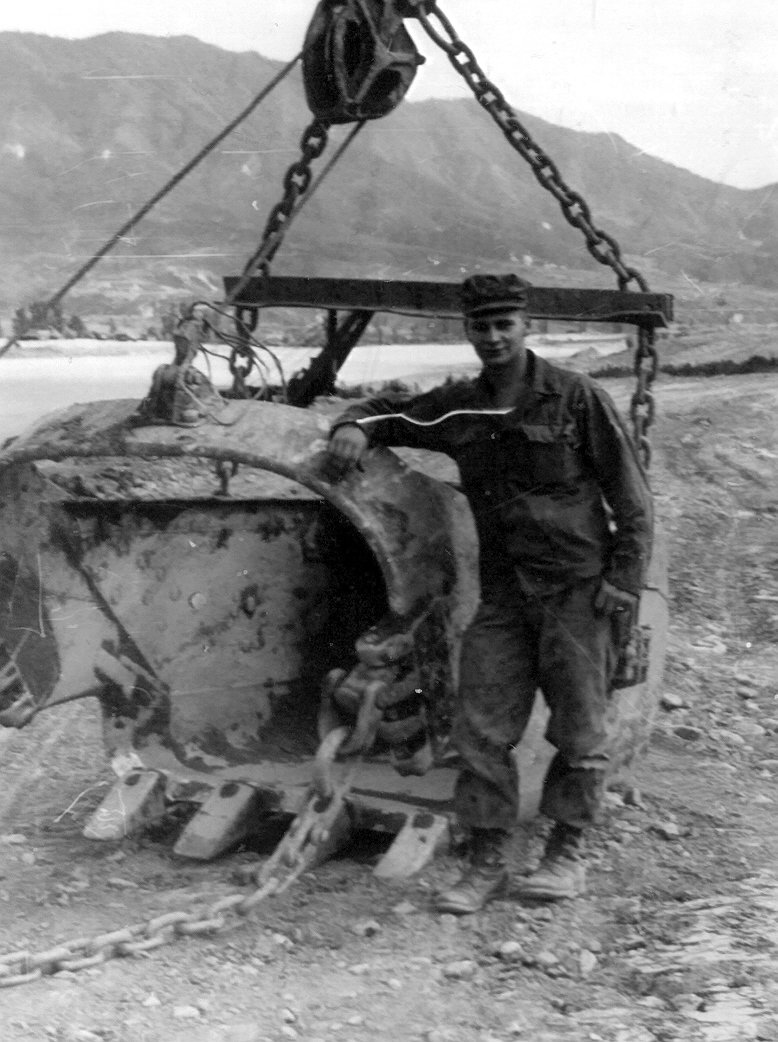
[KWE Note: Taken verbatim from the Unit History, 630th Engineers Company LE. Submitted to the KWE
by Floyd King of Johnstown, New York. Floyd was a 21-year old heavy equipment (dragline) operator in
Korea. Part of the K-52 airfield can be seen in the background.]
This unit was attached to the 19th Combat Engineer Group, came to Korea on October 7, 1950, worked its
way north to Hungnam area, was evacuated from there to Pusan, and began to work its way north again,
building roads and airfields.
Our largest project was to build the K-52 airfield near Yanggu, North Korea, beginning September 26,
1951. This was unfortunate because it left the winter time with its frozen ground in which to make the
large cuts and fills. The following seven months were spent with the entire company on the Yanggu
airfield. This was a 6500 foot airfield, 250 feet wide. It had two warm-up aprons, 450x300 feet,
a taxi-way 120 feet wide, 5000 feet long, and two adjacent parking aprons, one 300 feet by 850 feet and the
other 500 feet by 700 feet. It was designed for 40,000 pound wheel-loads, but actually was built much
stronger as a safety measure due to the fact that most sub-grade and base courses were of necessity placed
and stabilized during the winter time. Unfortunately, the most satisfactory location available was one
that spanned rice paddies and hills. Consequently, it was necessary to make cuts as deep as 30 feet
for thousands of feet and hundreds of feet wide and to follow these with fills as deep as 16 feet for
thousands of more feet. The completed job required the movement of two and a half million yards, the
construction of 3,374 feet of culvert with a cross section area as large as 64 square feet, the destruction
of a rock hill containing about 100,000 cubic yards, and the crushing of about 40,000 cubic yards of rock.
Most of this work was done under the worst weather conditions. The field was completed July 28, 1952,
except for the spreading of about 10,000 cubic yards of the crushed rock surfacing material. This was
the largest airfield completed in North Korea at that time. In July 1954, this airfield was turned
over to the Republic of Korea army.
The 630th Engineers built 22 airfields, ranging in length of 1200 feet to 6500 feet, K-52. The 1200
foot was built overnight at Chungju, January 3, 1951 for the use of 10th Corps liaison planes, the Stinson
L-17 sometimes called the "Grasshopper."
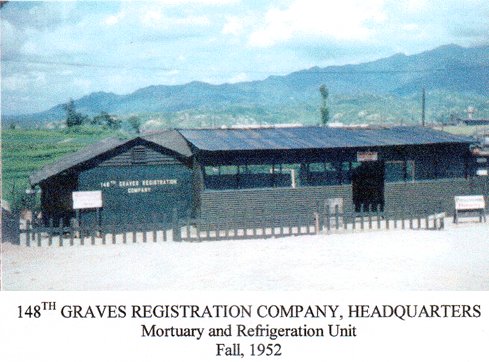
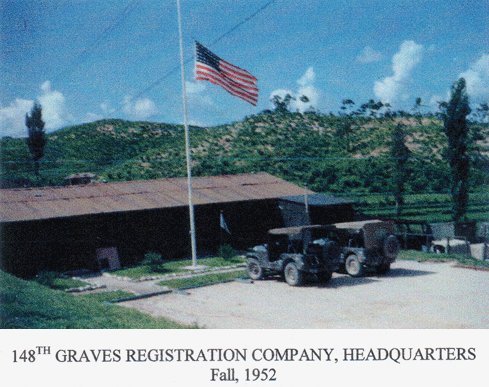
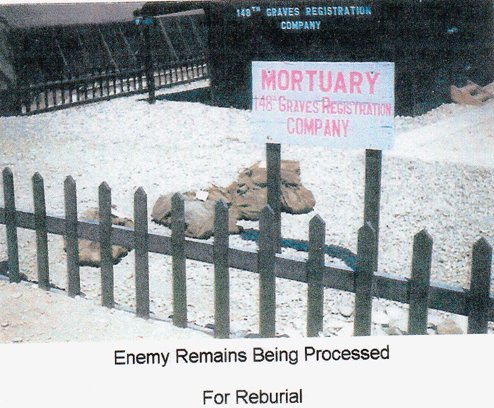
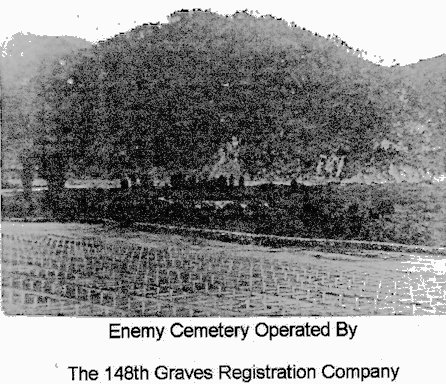
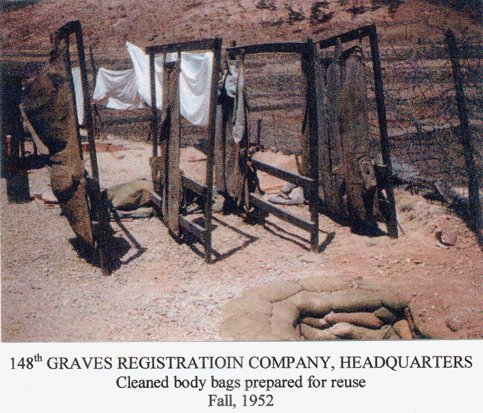
Back to Page Contents Graves Registration
Personnel associated with Graves Registration in Korea had the job to collect, evacuate, identify, and
bury deceased personnel. Much of the information found on this page was contributed to The Korean War
Educator by Graves Registration veteran Lynn Hahn of Whitehall, Michigan.
- Instruction for Trainees, Quartermaster Replacement Training Center, Ft. Lee, VA
- Graves Registration Specialist Duties and Qualifications
- Weekly Schedule, Graves Registration Course No. 10, 12-17 May 1952
- Memoirs – Lynn Hahn, Graves Registration Specialist
Back to Page Contents
Instruction for Trainees, Quartermaster Replacement Training Center, Ft. Lee, VA
[Submitted to the Korean War Educator by Lynn Hahn, Whitehall, MI.]
Graves Registration
Instruction for All New Trainees
The Quartermaster Replacement Training Center
The Quartermaster Center
Fort Lee, Virginia
1951
Subject: Instruction
To: All New Trainees
You are about to start eight weeks of basic training at the Quartermaster Replacement Training Center,
Fort Lee, Virginia. During this training, you must bear in mind that our present Army represents the finest
cross section of American Youth that can be brought together. They come from many walks of life. Their
standards of education, of ability, of honor, of ambition, are representative of American citizens. They
bring with them their likes and dislikes, their strengths and weaknesses, and collectively they represent
the opinions, the strength and weaknesses of our Country. The soldier of today is the best fighting man this
Nation has ever produced, with more spirit, more determination, and more ability than his predecessors.
The Quartermaster Replacement Training Center will train you so that you can uphold the tradition of
being the best fighting soldier in the world. However, your cooperation is needed in order for us to
accomplish and attain this goal. Listed below are some of the things that you must know after the completion
of your training. Check this list constantly during your training, so it will serve as your guide in doing
your part to maintain the tradition that the American soldier is the best trained soldier in the world.
- Know your General Orders.
- Know the number of your weapon.
- Know Military Law and your rights under Military Justice.
- Know what Article 15, UCMJ is and your rights under it.
- Know all about Enlisted Men sitting on Courts.
- Know all about the 31st Article, UCMJ.
- Know the three types of courts.
- Know Military Courtesy and how to apply it.
- How, when, and whom you salute.
- How to report to the Company Commander
- How to enter an Orderly Room.
- Courtesy extended in a Mess Hall.
- Know the rules of Land Warfare.
- The use of the white flag.
- Wearing enemy insignia
- What information you give if captured.
- Learn first aid.
- How you can assist an injured fellow soldier in the absence of a doctor.
- Know how to stop bleeding.
- Know how to treat him for shock.
- Know about fractures.
- Learn to read a map.
- Know how to orient a map by use of your compass, or by other means, such as your watch, stars,
landmarks, etc.
- Know symbols on a map, such as roads, buildings, schools, churches, contours, north lines, etc.
- Know that an "Azimuth" is an angle measured clockwise on a compass from a north line.
- Learn the meaning of the term "Back Azimuth".
- Know the Military Grid system which is a system of lines running North, South, East and West, on a
map for convenience in locating places. Learn the term "Coordinates" and what they are.
- Know the scales on various types of maps.
- Learn all you can about weapons, which are the soldier’s best friend. Learn to name the parts.
- Learn to be a good marksman. Know how to properly care for all weapons.
- Learn how to drill. Know how to handle your rifle. Be snappy. Be proud. Look like a soldier at all
times.
- Learn how soldiers fight and the proper position of each soldier in a quad.
- Know how to get to the ground, which is the soldier’s next best friend under fire. Know how to crawl
and hug the ground.
- Know the use of patrols and how to move slowly and cautiously at night without making noise.
- Know how to use your senses, such as sight, hearing, smell and touch. Know how to crawl under fire
without being injured.
- Know how to conceal yourself. Know the difference between "cover" and "concealment."
Know how to notice signs of enemy activity, both in daylight and at night.
- Learn the use of Grenades. The parts, the proper safety precautions.
- Know how to toss and fire Grenades.
- Know how to de-fuse a Grenade.
- How to assemble and fire a Rifle Grenade.
- Be sure to learn and know the "bazooka" or "rocket launcher." Know how to use it effectively and with
safety for yourself.
- Learn about Land Mines. Be able to describe a mine. Know how to neutralize it, or fix it so it will
not explode (by turning the top part to the left, removing it, and removing the fuse which makes it
explode). NB: This does not apply to all mines.
- Learn about poison gases, how they might effect your body, how to protect yourself from these agents.
- How to put on a Gas Mask and Spray Cover.
- Learn how to do on the Command of "Spray".
- How to clear a Gas Mask.
- Learn to protect yourself against Air and Armored Attack.
- Learn how to disperse and take cover.
- Learn how to protect yourself against radiological effects which might be caused by the Atomic Bomb.
- Know what Interior Guard Duty is.
- How many reliefs there are.
- Difference between Special and General Orders.
- How to challenge during the evening hours; and how to report fires.
- Know the proper methods of digging foxholes, of camouflage, of cover and concealment.
- Learn the correct methods of constructing Hasty Fortifications.
- Learn to protect yourself with a Bayonet, and Unarmed Defense.
- Know something about signal communications; the different types of radios, wire, how they are
installed, when they are used.
- Know the basis of Anti-Guerrilla Training and Anti-Infiltration.
- Learn the "how" and why, the importance of scouting and patrolling.
- Know the advantages of night tactical problems and training as compared with day training.
- Know the relationship of Personal Hygiene and Field Sanitation to the Individual soldier.
- Other things you must learn and do to be a good soldier are:
- To live, eat, sleep in the field.
- To care for your feet and to march over distances and still be able to fight when arriving at your
destination.
- Make the most of your opportunity now, taking advantage of valuable training which will make your
life better, either as a soldier or a civilian. Remember, most of our Great Leaders have been soldiers,
just as you are now. Observe your leaders. Pattern after them. Make up your mind to be a "leader." Be a
model soldier; know your profession of arms; set an example; be enthusiastic in your work; do not be
afraid to assume responsibility when called up to do so; develop proficiency; morale, pride of yourself
and your organization.
C.C. HOLCOMB
Colonel, QMC
Commanding
 (Click picture for a larger view) |
 (Click picture for a larger view) |
 (Click picture for a larger view) |
Back to Page Contents
Graves Registration Specialist Duties and Qualifications
[Contributed to the KWE by Lynn Hahn, Whitehall, MI.]
Graves Registration Specialist
Duties and Qualifications
The Quartermaster School
The Quartermaster Center
Fort Lee, Virginia
Qualification for MOS 4980
(Graves Registration Specialist) 130.579H1
Handout (to be issued in class)
December 1951
Graves Registration Specialist
Summary: Collects, evacuates, identifies, and buries deceased personnel subject to military jurisdiction,
collects and disposes of personal effects found on the deceased, and supervises work details engaged in
these tasks.
Duties: Collects, evacuates, and identifies the dead. Searches battlefields for unburied or unsuitably
buried dead and for isolated and unmarked graves. Covers the dead with raincoats or shelter halves and
carries them to forward area collecting points. Wraps bodies in blankets or other protective covering and
places them in ambulance or other vehicle for removal to rear area collecting points or to an established
cemetery. Searches dead, removes personal effects, and records inventory on appropriate form. Forwards
property and inventory on appropriate form. Forwards property and inventory forms to collecting point or
other specified place. Prepares identification form for each body showing name, service number, grade,
organization, and place, cause and date of death. Attaches one copy and forwards other copy to collecting
point or other designated place. Supervises work detail engaged in foregoing tasks. In the absence of
conclusive evidence of identity, takes fingerprints, or prepares tooth chart and ascertains other anatomical
characteristics. Operates fluoroscope to check skeleton structure for deformities, old fractures, and other
peculiar and signified bone formations. Records accurate physical description on prescribed form, giving all
anatomical characteristics, including scars, birthmarks, tattoo marks, and moles, which might be of aid in
identification. Informs non-graves registration personnel concerning preparation and disposition of graves
registration records. Maintains liaison between combat units and graves registration platoon and company
headquarters. Contact officers and enlisted personnel of units operating in areas where unidentified bodies
were found to obtain all available information which might be of aid in identification.
Buries the dead. Supervises work details engaged in burial of the dead in an established cemetery.
Oversees digging of graves, burial of bodies, and placing of appropriate marker at head of each grave.
Supervises and participates in burial of dead where found when circumstances prevent immediate burial in an
established cemetery. Ascertain that all personal effects have been removed from bodies. Oversees and
assists in digging graves and wrapping and burial of bodies. Attaches one of individual’s identification
tags to body and places other on marker at head of grave. Prepares report showing exact location of grave
and identity of body or bodies buried therein. Arranges for conduct of religious service and rendering of
military honors. In the absence of chaplain, conducts burial service. Indicates location of each temporary
grave on map, or on sketch prepared for the purpose. Accurately orients grave on map, or on sketch prepared
for the purpose. Accurately orients sketch by showing reference points or by sketching in or describing
prominent terrain features such as hills, ravines, streams, and roads. Submits report and map or sketch to
immediate superior or to other designated agency.
Qualifications: Must be able to perform duties described above and possess the following special
qualifications:
Must be able to read military and topographical maps, photomaps, and military and conventional signs and
symbols. Must be able to prepare topographical sketches and map overlays. Must be able to conduct burial
services in a solemn and reverent manner. Must be familiar with available disinfectants and fumigation and
their use in preventing infection and spread of contagious disease. Must be familiar with military honors
rendered at the grave and with other military funeral procedures. Must be familiar with methods used in
established cemeteries to make the graves of both known and unknown dead, and with method used to record
location of individual graves.
Examples of Duty Position for Which Qualified:
- Senior graves registration specialist, grade E-4 (corporal)
- Graves registration specialist, grade E-3 (private first class)
- Assistant graves registration specialist, grade E-2 (private)
After the corporal come sergeants, and there are quite a few in a graves registration company.
 (Click picture for a larger view) |
 (Click picture for a larger view) |
Back to Page Contents
Weekly Schedule, Graves Registration Course No. 10, 12-17 May 1952, 3rd Week
[Contributed to the KWE by Lynn Hahn, Whitehall, MI.]
The Quartermaster School
Fort Lee, Virginia
Each listed in the following order: Hours, place, instructor; Subject & Study Assignment; PI No. & Type
of Instruction
Monday, 12 May 1952
0700-0850, Class Leader will supervise movement of students to 1821, MSgt. Cramer. Radiological Warfare,
Defensive Measures & Employment, Required: Adv Sheet 149.500A; GR-2D-7, C, D, Restricted
0910-1100 & 1200-1350, 1689LR, MSgt. Roe. Personal Effects. Required: Chapter 6, ST 10-63-1, Bring to
class: Notebook & pencil; GR-2E-3, C, D, PE, Restricted
1400-1450, 1689LR, Pfc. Gorton. Map & Aerial Photo Reading; Military Sketching. Bring to class: Pencil &
paper; GR-2B-14, C, Restricted
1510-1600, Co Area, Sgt. Seay. Physical Conditioning – PT. Required: FM 21-20, par 49; all 12 exercises
plus Paratroop Shuffle
Tuesday, 13 May 1952
0700-0850, 1689LR, Sfc. Blaton & Pfc. Fee. Map & Aerial Photo Reading; Military Sketching. Review all
previous study assignments. Bring to class: all map reading equipment. GR-2B-15, E, Restricted.
0910-1000, 1689LR, Sfc. Blaton & Pfc. Fee. Map & Aerial Photo Reading; Military Sketching. Required: FM
21-36, pages 1-5. Bring to class: All map reading equipment. GR-2B-16, L, Restricted.
1010-1100 & 1200-1450, 1689LR, SFC Blanton & Pfc. Fee. Map & Aerial Photo Reading; Military Sketching.
Required: FM 21-35, pages 6-14. Bring to class: All map reading equipment. GR-2B-17, C, D, PE, Restricted.
1510-1600, Co Area, Sgt. Seay. Physical Conditioning – PT. Required: FM 21-20, par 49; all 12 exercises
plus Paratroop Shuffle.
Wednesday, 14 May 1952
0700-0750, 1689LR, Sfc. Ralston. Personal Effects. Required: Par 66, ST-10-63-1. Bring to class: ST
10-63-1, Notebook & pencil. GR-2E-4, C, PE, Restricted.
0800-1000, 1689LR, Sfc. Parks. Personal Effects. Recommended: Pars 64b-d, ST 10-63-1; par 65g-h, ST
10-63-1. Bring to class: Notebook & pencil. GR-2E-5, C, PE, Restricted.
1010-1100 & 1200-1250, 1689LR, Sfc. Blanton & Pfc Fee. Map & Aerial Photo Reading: Military Sketching.
Review all previous assignments. Bring to class: All map reading equipment. GR-2B-18, C, PE, Restricted.
1300-1350, 1689LR, MSgt. Roe. Iden of the Dead. Bring to class: Notebook & pencil. GR-2F-1, C, L,
Restricted.
1400-1450, Co Area, Sgt. Seay. Physical Conditioning – PT. Required: FM 21-20, par 49; all 12 exercises
plus Paratroop Shuffle.
1500-1550, Theater #5, Sgt. McKasson. Command Conference.
Thursday, 15 May 1952
0700-0850, 1689LR, Sfc. Blanton & Pfc. Fee. Map & Aerial Photo Reading; Military Sketching. Review all
previous assignments. Bring to class: All map reading equipment. GR-2B-19, C, PE, Restricted.
0910-1100 & 1200-1450, 1689LR, Cpl. McMaster. Iden of the Dead. Required: ST 10-63-1, Fig 34A & B, Fig
35; App II. QM 16-2, pages 50-59 incl. Bring to class: Notebook & pencil. GR-2F-2, C, PE, Restricted.
1510-1600, Co Area, Sgt. Seay. Physical Conditioning – PT. Required: FM 21-20, par 49; all 12 exercises
plus Paratroop Shuffle.
Friday, 16 May 1952
0700-1100 & 1200-1350, 1689LR, Sfc. Blanton & Pfc. Fee. Map & Aerial Photo Reading; Military Sketching.
Review all previous study assignments. Bring to class: All map reading equipment. GR-2B-20, PE, E,
Restricted.
1410-1500, Co Area, Sgt. Seay. Physical Conditioning – PT; Required: FM 21-20, par 49; all 12 exercises
plus Paratroop Shuffle.
Saturday, 17 May 1952
0700-0850, 1689LR, Sfc. Parks. Battlefield Collection & Evacuation. Recommended: Pars 35-39, ST 10-63-1.
Bring to class: Notebook & pencil. GR-2G-1, L, C, Restricted.
0910-1000, 1689LR, Sfc. Ralston. Personal Effects. Required: Pars 64 h, I, & j, ST 10-63-1. Bring to
class: ST 10-63-1; notebook & pencil. GR-2E-6, C, D, Restricted.
1010-1100, 1689LR, Sfc. Ralston. Personal Effects. Required: Par 68, ST 10-63-1. Recommended: Par 23, QM
Serv T/0 (120.20T). Bring to class: ST 10-63-1, QM Serv T/0 (120.20T), notebook & pencil. GR-2E-7, C,
Restricted.
 (Click picture for a larger view) |
 (Click picture for a larger view) |
 (Click picture for a larger view) |
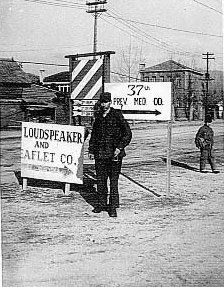
Back to Page Contents Loudspeaker & Leaflet
Psychological Warfare
1st Loudspeaker & Leaflet Company
Written by Paul A. Wolfgeher, Independence, Missouri
(Korea May 13, 1952-February 14, 1954)
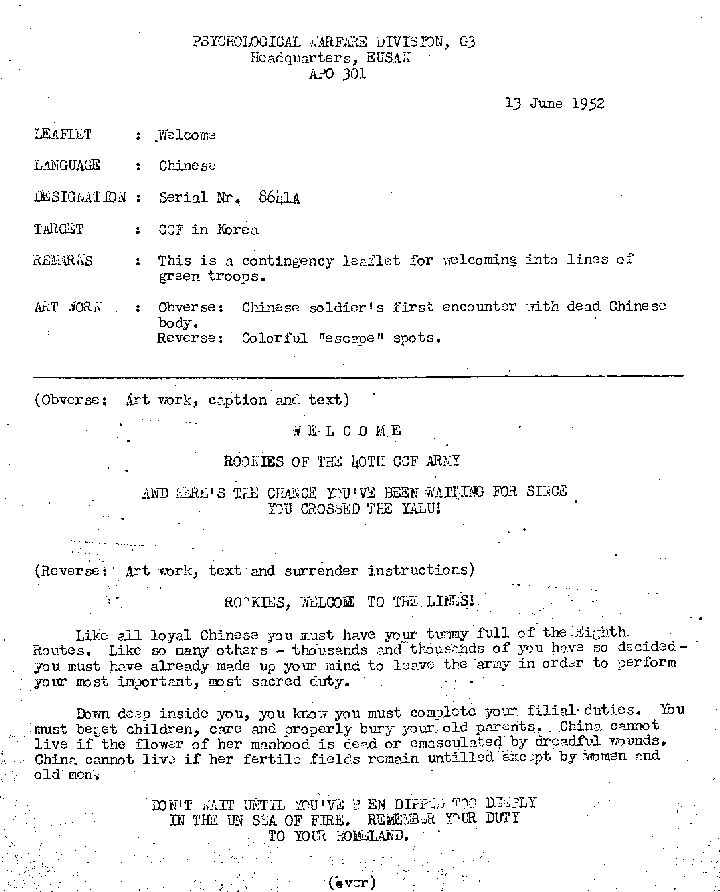
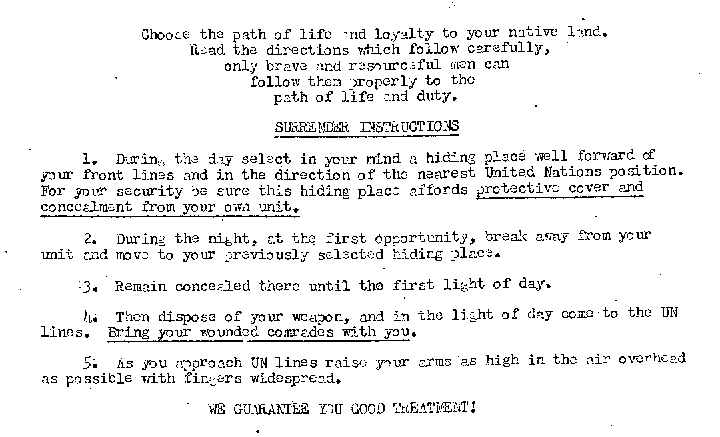
Less than 24 hours after President Truman ordered American troops to Korea, leaflets were being dropped
informing South Koreans of the decision of the United States and the United Nations. In less than another 24
hours, radio broadcasts were beamed towards South Korea. Theoretically, the first defense in Korea was
psychological warfare.
Back to Page Contents
Brief Background
Truth has been and still is one of the most effective weapons that man has found, and Psywar makes use of
the truth as its principal weapon to fight the enemy and reduce his will to fight. At first, Psywar in the
Far East consisted of a six-man planning group in Toyko, Japan. During the first 125 days of the Korean War,
over 100 million leaflets were dropped or fired in artillery shells by our forces.
The Korean War brought Psywar to the forefront. The infantry has the mission of meeting and destroying
the enemy. The artillery is dedicated to supporting the infantry by fire. And the mission of Psywar is to
support the infantry by reducing enemy combat efficiency. Psywar seeks to change enemy attitude and opinion
by means of the spoken or written word. The weapon is truth and it is one of the oldest, most effective
weapons upon which man has stumbled. The broad mission of Psywar is to hurt the enemy and depress the morale
of the enemy by spreading the "true" battle picture and of the U.N. aims of peace, unification, and
reconstruction. The only operational Psywar unit in the Army was at Fort Riley, Kansas. This unit was sent
to Korea as the 1st Loudspeaker and Leaflet Company. The 1st Loudspeaker and Leaflet Company arrived in
South Korea on November 4th, 1950, and served until February 21, 1955. (Another psywar unit—the 1st Radio
Broadcasting and Leaflet Company--arrived in Japan in the summer of 1951.)
The 1st Loudspeaker and Leaflet Company in Korea earned credit for participating in eight campaigns
during the Korean War and was awarded two meritorious unit commendations and a Republic of Korea
Presidential Unit Citation (ROKPUC). The 1st Loudspeaker and Leaflet Company served as the Army’s Tactical
Psychological Warfare unit until the end of the Korean War. This unit was the first of its kind to serve in
a combat zone, with loudspeakers on vehicles and aircraft, and which also disseminated propaganda from the
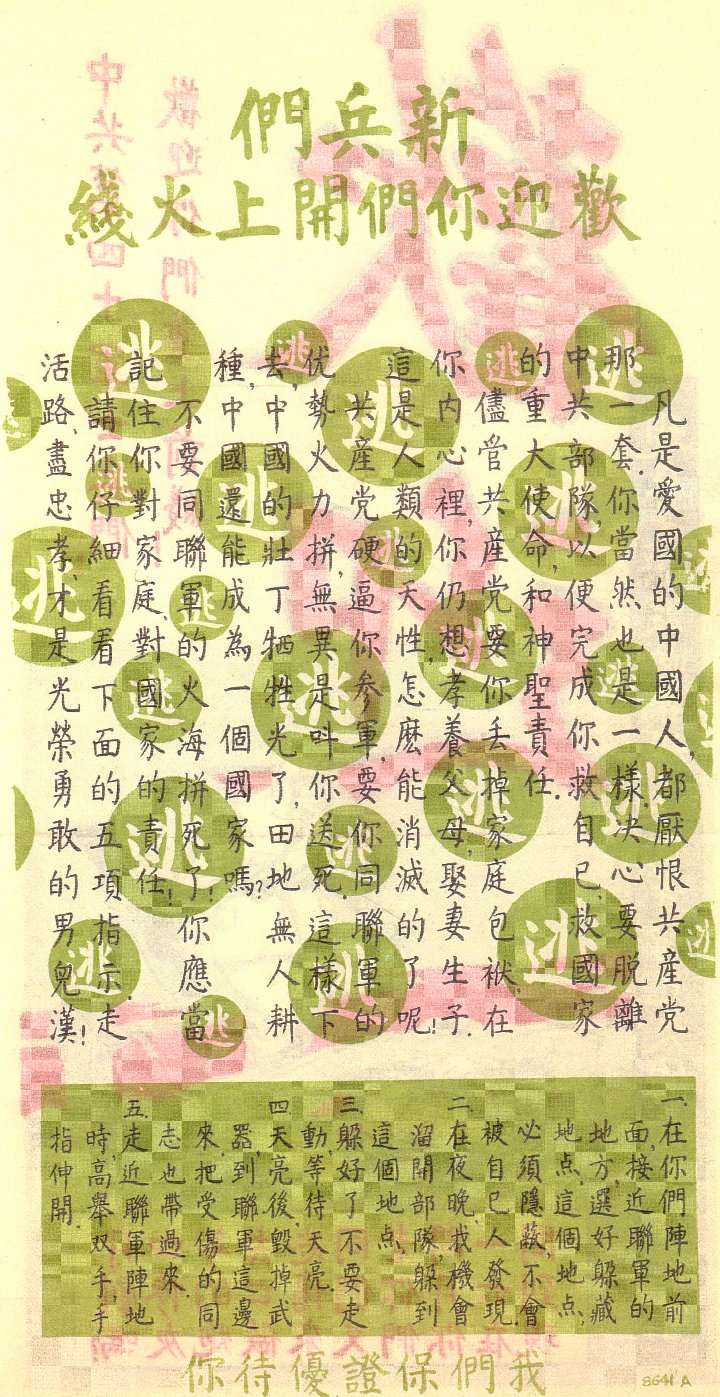
aircraft. Some of the leaflets promised medical treatment for frostbite, undermined faith in their officers,
and similarly instilled fear for soldiers’ safety. Another theme told of the mounting enemy dead.
Back to Page Contents
Operation Moolah
A leaflet drop is worthwhile if it causes significant decline in the combat efficiency of the enemy. One
big instance of this was Operation Moolah. This was a Psywar effort to entice Communist pilots to fly a Mig
15 fighter to an allied airfield for a reward of $100,000. Over one million leaflets were dropped near the
Yalu River on April 26, and another one half million were dropped near Sinuiju and Uiju airfields near the
Yalu border on May 10 and May 18. The Migs had been elusive in 1953, and it was difficult to get them to
come up and challenge the F-86 Sabre jets of the United States Air Force.
The result of this operation was the grounding of the Mig jets for eight days. It could have been the
weather, or perhaps the Communists were checking on pilots that might defect. In the 60 days before Moolah,
the allies shot down 53 Migs. In the 60 days after Moolah, the allies shot down 107 Migs. In the entire
period after Moolah, the allies shot down 165 Migs at a cost of losing only three allied aircraft—a 55 to 1
ratio.
We eventually got a Mig on September 21, 1953. North Korea had just opened the air base repair shop at
Pyongyang, and the pilot decided to make the 13-minute flight to freedom. Was this Moolah operation a
success? Yes, because it caused a flight to freedom and mass confusion among our enemies and destruction of
his aircraft. We dominated the skies afterward and I believe we can call that a success.
Back to Page Contents
Know Your Enemy
Psychological warfare is simply learning everything about your target enemy, their beliefs, likes and
dislikes, strengths, weaknesses, and vulnerabilities. How do you get to know your enemy target? By
intelligence reports, area studies, country research, defectors, and visiting prisoners of war.
Psychological warfare is a war of the mind, and your weapons are sight and sound. For your operations to
be effective, you must carefully plan your propaganda. Psywar operations are planned operations to convey
selected information and indicators to audiences to influence their emotion, motives, objective reasoning,
and ultimately the behavior of the organizations, groups, and individuals. Used in war, it is a powerful
weapon whose effectiveness is limited only by the ingenuity of the commander using it.
The success of Psywar starts with knowing its capabilities. To be successful, Psywar operations must be
planned, synchronized, and executed successfully. Failure in one results in failure in the whole plan.
During the Korean War, it was a no no for enemy soldiers to have a leaflet on their person. If found on
them, they were shot. Consequently, smaller leaflets were used so that they could be hidden more easily and
read at a later date. Some leaflets were printed as money so the enemy soldiers could hide the leaflets
between the real money he had. It was normal practice to send the enemy leaflets that he recognized, news
that he missed, and things he knew about. One leaflet that exceeded all others in production was the Safe
Conduct Pass. It had to be sincere and standardized.
Back to Page Contents
The Loudspeaker
Tactical Psywar was employed for surrender instructions, to discourage and disrupt enemy operations,
control civilians, warn of potential bombings of enemy targets, etc. Psywar soldiers used several types of
media, audio, visual and print, but during most combat operations, Loudspeaker Systems were used for
face-to-face communications. Loudspeaker Teams in Korea consisted of a US soldier, normally a sergeant who
was in charge; one Korean soldier who could speak English and Korean; and a Korean soldier who could speak
Korean and Chinese.
The Loudspeaker was a major weapon in Korea. Ground loudspeakers were used on the radio-less North Korean
front. Loudspeakers were also used from aircraft to stimulate or control enemy movements. The best example
of this was a case where a Loudspeaker plane saw a northbound column of Communist trucks that were warned to
turn around and head for U.N. lines or they would be shot at by the fighter planes that were circling
overhead.
On occasion, the voice and leaflet planes were damaged by Communist Anti-aircraft Artillery, and planes
were lost. A good number of ground loudspeakers were destroyed by intense enemy counter fire to halt
broadcasts. There was this time we sent a few thousand leaflets up to the front to our loudspeaker team,
which was going to use them. But before the team could use them or destroy them, the hill was overrun by the
enemy and the leaflets were confiscated by the enemy. A couple of days later the enemy flew over Seoul in
their Bed Check Charlie planes and dropped those leaflets on our compound. They knew exactly where we were
located. Their intelligence was just as good as ours.
Back to Page Contents
Leaflets
Leaflets are the work-horse of Psywar. After the North Koreans crossed the 38th parallel on June 25,
1950, enough leaflets were used in Korea to provide one for every person on earth. Leaflets were dropped by
leaflet bombs and timed fused bundles. They were shot across the lines by leaflet shells, and carried and
distributed by infantry patrols.
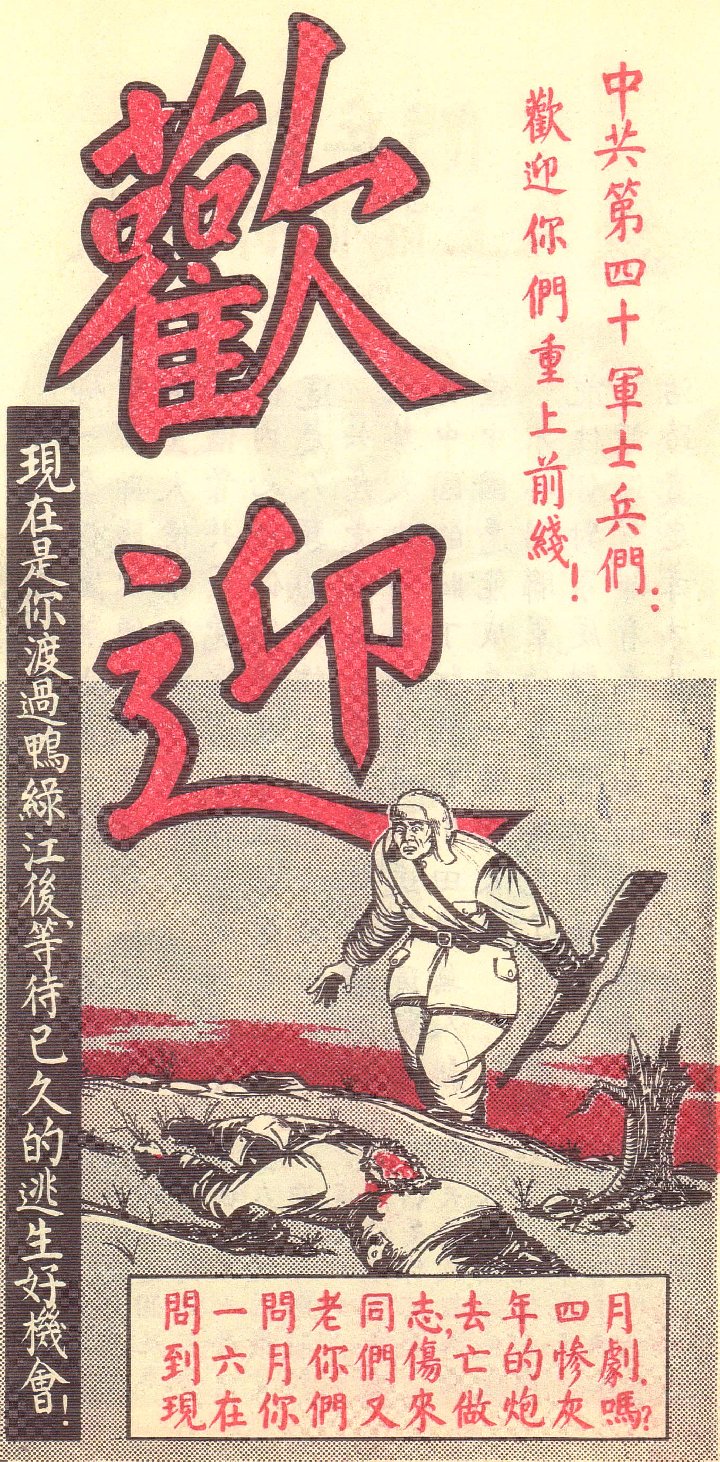
The standard size of a leaflet used in Korea was 5 ½ x 8 ½. These leaflets could be retained and passed
on from person to person without distortion. The leaflet could be hidden and read later in privacy.
A properly developed and designed message can have a deep and lasting effect on the target audience. The
heading of the leaflet is the most important part because it is what your eyes see first. It has to be
forceful and short, gain the interest of the target audience, and contain actual facts and details. Color on
a leaflet should contrast sharply with the predominant color of the terrain over which the leaflet will be
used. It has to stand out so that the individual would want to pick it up. Through intelligence you can
learn the favorable colors of the target audience.
Pictures on leaflets showing bombed enemy cities are proof to the soldier that their homeland is subject
to air raids. During the Korean War, the leaflet themes centered around the happy POW, good soldiers, bad
leaders, surrender, you will be treated well, and nostalgia for home, family, and woman.
There are some disadvantages to leaflets. A high illiteracy rate can reduce the effectiveness of the
message. They require special extensive and continuing logistic support. The enemy can collect and destroy
them or prohibit the possession of them by death.
The leaflet development and design requires trained and knowledgeable personnel. They must know the
situation at the moment the leaflet is to be used. Leaflets were developed for standard uses, as special
situations, safe conduct passes, and news of what is happening. Only positive appeals can wear down the
barrier the enemy has erected against the Psywar writer. The work of a Psy warrior was top notch.
Back to Page Contents
Leaflets from the Air/Bombs
Leaflets dropped by air usually follow the effects of air current and there were drops when the air
stream would change and our UN troops would receive them.
The leaflets dropped by leaflet bombs weighed 225 pounds fully loaded with 30,000 5 ½ x 8 ½ fliers.
Before the leaflets were placed in the bomb, the fuse was placed in the seam between the two halves. It
functioned at a predetermined time, denoting the primer cord, separating the two body sections, detaching
the fins and releasing the leaflets.
Back to Page Contents
The Victory of Psywar
There is little likelihood of learning the total effect of Psywar in Korea. Today’s Psy Warriors are
soldiers first and radiopersons, printers, or psychologists second. Our unit always considered that if one
person surrendered with a leaflet, that was one soldier not shooting at United Nations troops. By the end of
the Korean War, 2.5 billion leaflets had been dropped over enemy troops and civilians in North Korea. About
one million individual leaflets could be distributed by a single B-29 Superfortress. The reliance of C-47
Transport Aircraft as a way of disseminating leaflets and the use of Voice Planes at the tactical level were
uncomplicated by enemy air or anti-craft action.
The most stunning victory for the United Nations was the refusal of 33,000 POWs to return to their
homelands, and in contrast only 21 UN military personnel refused repatriation.
In 1957, the term Psychological Warfare was replaced by Psychological Operation, in recognition of the
fact that such operations did not require a state of war and they could be directed toward civilians.
Back to Page Contents
News Article
Name of publication unknown; Date unknown
(written sometime during the Korean War)
Submitted to the Korean War Educator by
Paul Wolfgeher, Independence, MO
Psywar Hits Korean Enemy
Right Where it Hurts the Most
With the Eighth Army, Korea -
The strenuous nightly climb to work was made a little easier for Mr. Kim on this rainy night as three
searchlights on the next ridge cast an eerie light. Mr. Kim could barely distinguish the last few footholds,
but as he gained the top of the mountain he could see more clearly. He started to set up for the night's
work.
First the generator. Good, he thought, as it started without difficulty. He checked the dial to insure
that there was enough power, then connected the "mike," placed a harmonica to his lips and began the first
broadcast of the evening. From a loudspeaker unit, some 300 yards in front of the MLR, came the strains of
the soulful harmonica solo, followed with a resume of the current news in flawless Chinese for the news
starved Communists. Thus, an obscure bunker on an isolated hill once again became the final link in the
PSYWAR chain.
Psychological Warfare (PSYWAR), a weapon as old as history itself, is waged in Korea through the combined
efforts of approximately 350 Americans and Koreans. They use propaganda and related measures which are
designed to decrease the effectiveness of the enemy in this "hot and cold" war. Standing as the "Heart of
PSYWAR" in Korea is the 1st Loudspeaker and Leaflet Co., commanded by Capt. Oliver W. Rodman. The 1st L&L,
which arrived in Korea in the early autumn of 1950 as a Tactical Information Detachment, is the first unit
of its kind in this or any other theater, and is the only one to serve in combat.
In preparing each new program which will strike at the morale of the Communist forces, the Intelligence
Branch of the Eighth Army Psychological Warfare Division first evaluates the psychological vulnerability of
the enemy. This information is passed along to the Projects Branch, whose artists and writers design the
propaganda leaflets.
After materials are fused in a finished product, translated and approved, they are sent to the 1st L&L
Co., where the leaflets are reproduced. Meanwhile, speaker teams are writing scripts which will elaborate
the theme of the leaflets. When reproduction is completed, Capt. Rodman calls in the section leaders, who
will conduct the operation, and explains the objective of the program. The section leaders return to their
headquarters and brief the team chiefs who have written scripts for the coming attack.
On the appointed date, the operation swings into action. Although the Operations Branch of PSYWAR has
many ways of disseminating its material, the usual methods are stationary loudspeakers and leaflets dropped
from airplanes. In the case of a fluid front, speakers are mounted on tanks, while loudspeakers rigged to
airplanes is another method used in Korea. The use of airplanes is ideal in cases where the civilian
population is the object of the message. Planes are seldom used against ground forces, because they would be
too easy to shoot down.
The use of artillery shells permits the section leaders to pinpoint a target, while leaflets dropped from
airplanes cover a general area.
As the hour of the proposed operation approaches, the team chiefs move out to their respective units and
brief their men on the night's program. In a team there are usually two other members, one who broadcasts
and one who can interpret English, Chinese and Korean.
At advanced airbases, planes are loaded with leaflets that will be dropped to coincide with the
broadcasts. If necessary, artillery pieces will send shells into enemy territory with the same message. The
success of the campaign now depends on the intellectual and emotional make-up of the enemy. Will the ancient
folk tunes of his country cause him to stop and think about his home? Can the leaflets make him believe that
he is the pawn of a foreign government?
Reports from Communist prisoners indicate they listen to broadcasts and read the leaflets even though
they are subject to punishment for doing so.
(Click a small picture for a larger
view)
 |
 |
 |
 |

Leaflet |

Leaflet |

Leaflet |

Leaflet |
Back to Page Contents Military Police
728th Military Police
According to this history, the 728th was initially activated January 19, 1942 at Fort Custer, Michigan.
Originally used to train troops for combat duty and maintain "alert status" for protection of war production
industries in Detroit, Michigan, the 728th remained on US soil until August 1950. The battalion was then
alerted for overseas movement to Yokohama, Japan. Following the North Korean invasion of the South, the
728th was transferred and reassembled in Pusan, South Korea. Its new mission during the Korean War was
operation and control of traffic on the Green Diamond Main Supply Route. For the next eight months, many
members of the unit took an active part in combat operations in surpassing guerilla activities and
responding to ever changing tactical situations.
The battalion made a number of moves during its 30 year history in the Republic of Korea, including
Pyongyang, Seoul, Taejon, Yongju, Wonju, Chipyoungni, Hongchon, and Chunchon. The photograph of MPs Fuller,
Thompson, Parido, Mays, Jacobson, Goldberg and Gilbreath (far right) was taken at a place called "The Rock
Pile."After the Inchon invasion, the battalion headquarters was moved to Inchon and later, as security
increased, found its way to Seoul. In 1951, the battalion assisted in traffic control and various other law
enforcement duties. After the truce was signed, the 728th mission was to provide military police support to
installations around the Republic of Korea and, when necessary, keeping peace on the peninsula. One of the
more well-known missions of the 728th was rendering assistance in the return of the crewman of the USS
Pueblo who had been captured and incarcerated by the North Koreans. Members of the battalion were present at
Panmunjom to accept release and provide security. In 1984, the 728th was incorporated into the 8th Military
Police provisional brigade at Seoul. These three 728th Military Police Battalion photographs are shown
courtesy of Don Parido of Illinois. He is standing next to the jeep in the first photo on the left.
 (Click picture for a larger view) |

(Click picture for a larger view) |
 (Click picture for a larger view) |
Back to Page Contents Postal
Back to Page Contents Quartermaster
|